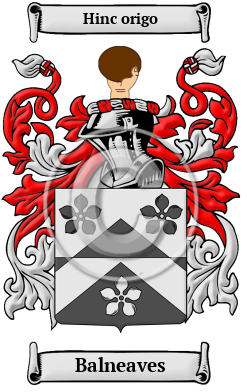
| ![Show Contents]() Balneaves History, Family Crest & Coats of Arms Balneaves History, Family Crest & Coats of Arms
- Origins Available:
Scotland
Etymology of BalneavesWhat does the name Balneaves mean? The ancestors of the first family to use the name Balneaves lived among the ancient Scottish people called the Picts. The Balneaves family lived in the lands of Balneaves in the parish of Kinkell in Angus. The name is a topographic or local surname, which was given to a family who held a barony or lands, had houses, manors or estates in the area. Even today, there is a small farm in the area called Balneaves. Early Origins of the Balneaves familyThe surname Balneaves was first found in Angus (Gaelic: Aonghas), part of the Tayside region of northeastern Scotland, and present day Council Area of Angus, formerly known as Forfar or Forfarshire, where they held a family seat from very ancient times, some say before the eleventh century. They held a family seat on the lands of Balneaves in the parish of Kinkell, the site is still marked by three aged trees, which are bounded by Kyrkness and Louchor. Laurence Balnaves attended the beating of the boundaries of his territories in 1395. Early History of the Balneaves familyThis web page shows only a small excerpt of our Balneaves research. Another 96 words (7 lines of text) covering the years 1513, 1538, 1539, 1542, 1579, 1587 and 1597 are included under the topic Early Balneaves History in all our PDF Extended History products and printed products wherever possible. Balneaves Spelling VariationsIn the Middle ages, spelling and translation were not yet regulated by any general rules. spelling variations in names were common even among members of one family unit. Balneaves has appeared Balneaves, Balnaves, Balnavis, Banese, Bannese, Bennase, Bennese, Benes and many more. Early Notables of the Balneaves familyHenry Balnaves (d. 1579), Scottish reformer, usually described as of 'Halhill' after a small estate belonging to him in Fifeshire. "He was born in Kirkcaldy during the reign of James V of Scotland (1513-1542); but the exact date is unknown. He proceeded in very early youth to the university of St. Andrews, and afterwards, it is said, to Cologne...
Another 58 words (4 lines of text) are included under the topic Early Balneaves Notables in all our PDF Extended History products and printed products wherever possible. Migration of the Balneaves familyFaced by this persecution and the generally unstable political climate of those days, many Scots chose to leave their homeland for Ireland, Australia, and North America in search of greater opportunity and freedom. The colonies across the Atlantic were the most popular choice, but a passage there was neither cheap nor easily suffered. Passengers arrived sick and poor, but those who made it intact often found land and more tolerant societies in which to live. These brave settlers formed the backbone of the burgeoning nations of Canada and the United States. It is only this century that the ancestors of these families have begun to recover their collective identity through the patriotic highland games and Clan societies that have sprung up throughout North America. Research into early immigration and passenger lists revealed many immigrants bearing the name Balneaves: Richard Benes who settled in Barbados in 1635; Bennett Bennes settled in Virginia in 1652; Ann Bennes settled in Virginia in 1654; John Bennes landed in Philadelphia, Pennsylvania in 1868..
| Contemporary Notables of the name Balneaves (post 1700) | + |
- Claire Balneaves, American co-founder and chorister of the Military Wives Choirs Foundation in March 2012
- Lynda Balneaves, American president of the Society for Integrative Oncology, a multidisciplinary professional society dedicated to studying how to apply evidence-based integrative medicine to the treatment of cancer
- Elizabeth Balneaves (1911-2006), Scottish author, painter and filmmaker from Aberdeen, best known as the author of The Windswept Isles (1977)
- Andrew Balneaves, New Zealand politician, Mayor of Mataura, a town in the Southland region of the South Island of New Zealand (1909-1912)
The motto was originally a war cry or slogan. Mottoes first began to be shown with arms in the 14th and 15th centuries, but were not in general use until the 17th century. Thus the oldest coats of arms generally do not include a motto. Mottoes seldom form part of the grant of arms: Under most heraldic authorities, a motto is an optional component of the coat of arms, and can be added to or changed at will; many families have chosen not to display a motto.
Motto: Hinc origo
Motto Translation: Hence our origin.
 |