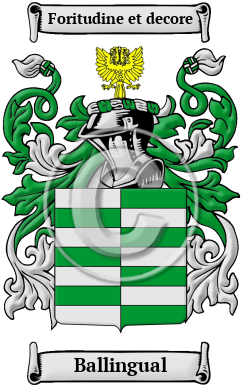
Ballingual is a name whose ancestors lived among the Picts, a tribe in ancient Scotland. The Ballingual family lived in the lands of Ballinghall in Kinross. The name is a topographic or local surname, which was given to a family who held a barony or lands, had houses, manors or estates in the area.
Loading...
Early Origins of the Ballingual family
The surname Ballingual was first found in on the lands of Kinross, where they have held a family seat from very ancient times. They have held the lands of Ballingall, in the parish of Orwell in that shire for many centuries.
Early History of the Ballingual family
This web page shows only a small excerpt of our Ballingual research. Another 53 words (4 lines of text) covering the year 1566 is included under the topic Early Ballingual History in all our PDF Extended History products and printed products wherever possible.
Ballingual Spelling Variations
The appearance of the printing press and the first dictionaries in the last few hundred years did much to standardize spelling. Prior to that time scribes spelled according to sound, a practice that resulted in many spelling variations. Ballingual has been spelled Ballingal, Ballingall, Ballinghall, Ballengall, Bangall, Balingual, Ballingaw and many more.
Early Notables of the Ballingual family
More information is included under the topic Early Ballingual Notables in all our PDF Extended History products and printed products wherever possible.
Migration of the Ballingual family to Ireland
Some of the Ballingual family moved to Ireland, but this topic is not covered in this excerpt. Another 34 words (2 lines of text) about their life in Ireland is included in all our PDF Extended History products and printed products wherever possible.
Loading...
Loading...
Loading...
Loading...
Migration of the Ballingual family
The expense of the crossing to the North American colonies seemed small beside the difficulties of remaining in Scotland. It was a long and hard trip, but at its end lay the reward of freedom. Some Scots remained faithful to England and called themselves United Empire Loyalists, while others fought in the American War of Independence. Much of this lost Scottish heritage has been recovered in the last century through Clan societies and other patriotic Scottish organizations. A search of immigration and passenger lists revealed many important, early immigrants to North America bearing the name of Ballingual: Alexander and Roger Ballingall who settled in Boston, Massachusetts in 1755; Daniel Ballinger settled in New England in 1740.
The motto was originally a war cry or slogan. Mottoes first began to be shown with arms in the 14th and 15th centuries, but were not in general use until the 17th century. Thus the oldest coats of arms generally do not include a motto. Mottoes seldom form part of the grant of arms: Under most heraldic authorities, a motto is an optional component of the coat of arms, and can be added to or changed at will; many families have chosen not to display a motto.
Motto: Foritudine et decore Motto Translation: By boldness and gracefulness.
Remove Item
WARNING!
Removing this item from your shopping cart will remove your associated sale items.
Are you sure you want to delete this item from your shopping cart?
HouseofNames E-Newsletter Sign Up
On Demand Gifts | Digital Products Available 24/7
A Gift for Everyone on your List is a Click Away - Shop Now