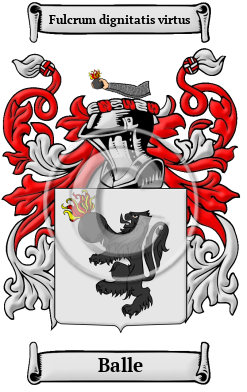
| ![Show Contents]() Balle History, Family Crest & Coats of Arms Balle History, Family Crest & Coats of Arms
Etymology of BalleWhat does the name Balle mean? The name Balle is of Anglo-Saxon origin. It was name for a person who was bald deriving its origin from the Old English word Bealla, which meant bald. The surname may also refer to someone who had a rotund or stocky stature. 1 While many researchers share this same "nickname" origin of the name, Henry Brougham Guppy in 1890, wrote "The idea that these names originated from bald - headed ancestors is, I think, absurd. Camden, in his remarks on surnames, written some 300 years ago, informs us that Baul and Bald were then nicknames or nursenames for Baldwin, and it was evidently from this source that Mr. Lower borrowed the suggestion that Ball was a nickname of Baldwin." 2 Early Origins of the Balle familyThe surname Balle was first found in the "west side of England, being at present most numerous in Lancashire, Staffordshire, Warwickshire, and Gloucestershire. This surname must be distinguished in its distribution from Balls, which is restricted to the opposite or east side of England, in the counties of Norfolk, Suffolk, and Essex. It is remarkable that after the lapse of six centuries Balls remains doggedly in the same part of England, whilst Ball and Baldwin seem to have extended their areas westward. In Norfolk three centuries ago Balls was sometimes spelt Balles or Ballis. " 2 The earliest record of the family was found in the Hundredorum Rolls of 1273 which reflected the scattered occurrences of the family and early spellings recorded: Custance Balde, Cambridgeshire; Richard Bald, Oxfordshire; John Balle, Norfolk; and Albred Balle, Huntingdonshire. 1 Kirby's Quest had several entries: John Balde, Somerset, 1 Edward III (recorded during the first year's reign of Edward III.) John atte Balle, Somerset, 1 Edward III; and Henry atte Balle, Somerset, 1 Edward III. 3 John Ball (d. 1381), was an early English priest, who provoked the insurrection of Wat Tyler. As a result of his actions, he was "brought before the king at St. Albans, where he was sentenced to be hanged, drawn, and quartered as a traitor. The sentence seems to have been promptly carried out, and the king himself witnessed its execution at St. Albans on 15 July. " 4 Early History of the Balle familyThis web page shows only a small excerpt of our Balle research. Another 161 words (12 lines of text) covering the years 1381, 1530, 1553, 1585, 1590, 1623, 1626, 1631, 1637, 1639, 1640, 1659, 1664, 1665, 1675, 1680, 1681, 1690, 1731, 1745, 1887, 1890 and 1992 are included under the topic Early Balle History in all our PDF Extended History products and printed products wherever possible. Balle Spelling VariationsSpelling variations in names were a common occurrence before English spelling was standardized a few hundred years ago. In the Middle Ages, even the literate spelled their names differently as the English language incorporated elements of French, Latin, and other European languages. Many variations of the name Balle have been found, including Ball, Balle, Balls, Balders and others. Early Notables of the Balle family- William Ball or Balle (c. 1631-1690), was an early an English astronomer, one of the founding Fellows of the Royal Society. He was the eldest of seventeen children born to Sir Peter Ball, knight, reco...
- Peter Ball or Balle, M.D. (died 1675), was an English physician, honorary fellow of the Royal College of Physicians in December 1664
- Robert Balle (c.1639-1731), of Mamhead, Devon; Campden House, Kensington, London; and Leghorn, Italy, was an English Member of Parliament (MP) and son of Sir Peter Balle, MP for Tiverton
Balle RankingIn France, the name Balle is the 6,133rd most popular surname with an estimated 1,000 - 1,500 people with that name. 5 Migration of the Balle family to IrelandSome of the Balle family moved to Ireland, but this topic is not covered in this excerpt.
Another 181 words (13 lines of text) about their life in Ireland is included in all our PDF Extended History products and printed products wherever possible.
| Balle migration to the United States | + |
Families began migrating abroad in enormous numbers because of the political and religious discontent in England. Often faced with persecution and starvation in England, the possibilities of the New World attracted many English people. Although the ocean trips took many lives, those who did get to North America were instrumental in building the necessary groundwork for what would become powerful new nations. Among early immigrants of the Balle surname to cross the Atlantic and come to North America were:
Balle Settlers in United States in the 17th Century- Dorothy Balle, who landed in America in 1654 6
Balle Settlers in United States in the 18th Century- Balle, who was a joiner and landowner in New Orleans and lived with his wife in 1732
Balle Settlers in United States in the 19th Century- A Del Balle, aged 45, who arrived in New Orleans, La in 1831 6
- M Balle, aged 4, who arrived in New Orleans, La in 1831 6
| Contemporary Notables of the name Balle (post 1700) | + |
- Carl Christian Nicolaj Balle (1806-1855), Danish composer and editor of church music
- Francis Balle (b. 1939), French academic teacher and searcher
The motto was originally a war cry or slogan. Mottoes first began to be shown with arms in the 14th and 15th centuries, but were not in general use until the 17th century. Thus the oldest coats of arms generally do not include a motto. Mottoes seldom form part of the grant of arms: Under most heraldic authorities, a motto is an optional component of the coat of arms, and can be added to or changed at will; many families have chosen not to display a motto.
Motto: Fulcrum dignitatis virtus
Motto Translation: Virtue is the support of dignity
- Bardsley, C.W, A Dictionary of English and Welsh Surnames: With Special American Instances. Wiltshire: Heraldry Today, 1901. Print. (ISBN 0-900455-44-6)
- Guppy, Henry Brougham, Homes of Family Names in Great Britain. 1890. Print.
- Dickinson, F.H., Kirby's Quest for Somerset of 16th of Edward the 3rd London: Harrison and Sons, Printers in Ordinary to Her Majesty, St, Martin's Lane, 1889. Print.
- Smith, George (ed), Dictionary of National Biography. London: Smith, Elder & Co., 1885-1900. Print
- http://www.journaldesfemmes.com/nom-de-famille/nom/
- Filby, P. William, Meyer, Mary K., Passenger and immigration lists index : a guide to published arrival records of about 500,000 passengers who came to the United States and Canada in the seventeenth, eighteenth, and nineteenth centuries. 1982-1985 Cumulated Supplements in Four Volumes Detroit, Mich. : Gale Research Co., 1985, Print (ISBN 0-8103-1795-8)
 |