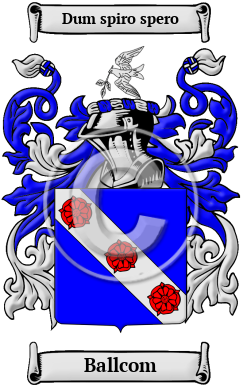
| ![Show Contents]() Ballcom History, Family Crest & Coats of Arms Ballcom History, Family Crest & Coats of Arms
- Origins Available:
Scotland
England
Etymology of BallcomWhat does the name Ballcom mean? The Pictish clans of ancient Scotland were the ancestors of first people to use the name Ballcom. The name was found in Balcomie, in the parish of Crail, in the county of Fifeshire. 1 Early Origins of the Ballcom familyThe surname Ballcom was first found in Fife, where one of the first records of the family was "Robert de Balcomie who was constable of Crail in 1297 is probably the Robert de Balcomi who served as juror on an inquest made at Perth in 1305. John de Balcolmy was bailie of Crail in 1359, and c. 1380 mention is made of the lands of Richard de Balcolmi in the same town. Thomas de Balcolmi appears in record in 1429, James Balcolmy was married in 1492." 1 In England, the family is thought to have originated at Balcombe (Baegloc's hollow), in Sussex. 2 3 In this case, the place name dates back to the late 11th century when it was known as Balecumba and possible meant "valley of a man called Bealda." 4 Early feudal rolls provided the king of the time a method of cataloguing holdings for taxation, but today they provide a glimpse into the wide surname spellings in use at that time. John de Balecomb was listed in Sussex in 1327 as was Thomas Bakombe in the Subsidy Rolls for 1525. 5 Early History of the Ballcom familyThis web page shows only a small excerpt of our Ballcom research. Another 62 words (4 lines of text) covering the years 1297, 1359, 1380 and 1672 are included under the topic Early Ballcom History in all our PDF Extended History products and printed products wherever possible. Ballcom Spelling VariationsIn the Middle ages, spelling and translation were not yet regulated by any general rules. spelling variations in names were common even among members of one family unit. Ballcom has appeared Balcom, Balcome, Balcomb, Balcomm, Balcombe and others. Early Notables of the Ballcom familyMore information is included under the topic Early Ballcom Notables in all our PDF Extended History products and printed products wherever possible. Migration of the Ballcom familyFaced by this persecution and the generally unstable political climate of those days, many Scots chose to leave their homeland for Ireland, Australia, and North America in search of greater opportunity and freedom. The colonies across the Atlantic were the most popular choice, but a passage there was neither cheap nor easily suffered. Passengers arrived sick and poor, but those who made it intact often found land and more tolerant societies in which to live. These brave settlers formed the backbone of the burgeoning nations of Canada and the United States. It is only this century that the ancestors of these families have begun to recover their collective identity through the patriotic highland games and Clan societies that have sprung up throughout North America. Research into early immigration and passenger lists revealed many immigrants bearing the name Ballcom: Alexander Balcom, who came to Rhode Island in 1664, Henry Balcom, who is on record in Charlestown, MA in 1664; Jonas Balcom, who arrived in Nova Scotia some time between 1735-1835.
The motto was originally a war cry or slogan. Mottoes first began to be shown with arms in the 14th and 15th centuries, but were not in general use until the 17th century. Thus the oldest coats of arms generally do not include a motto. Mottoes seldom form part of the grant of arms: Under most heraldic authorities, a motto is an optional component of the coat of arms, and can be added to or changed at will; many families have chosen not to display a motto.
Motto: Dum spiro spero
Motto Translation: While I have breath I hope.
- Black, George F., The Surnames of Scotland Their Origin, Meaning and History. New York: New York Public Library, 1946. Print. (ISBN 0-87104-172-3)
- Smith, Eldson Coles, New Dictionary of American Family Names New York: Harper & Row, 1956. Print
- Lewis, Samuel, A Topographical Dictionary of England. Institute of Historical Research, 1848, Print.
- Mills, A.D., Dictionary of English Place-Names. Oxford: Oxford University Press, 1991. Print. (ISBN 0-19-869156-4)
- Reaney, P.H and R.M. Wilson, A Dictionary of English Surnames. London: Routledge, 1991. Print. (ISBN 0-415-05737-X)
 |