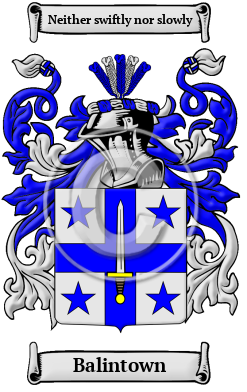
| ![Show Contents]() Balintown History, Family Crest & Coats of Arms Balintown History, Family Crest & Coats of Arms
- Origins Available:
Scotland
Ireland
Etymology of BalintownWhat does the name Balintown mean? The ancestors of the Balintown family lived among the Strathclyde-Briton people of the Scottish/English Borderlands. Balintown is a name for someone who lived in Roxburghshire, where the family was found since the early Middle Ages. One source claims the name was of local origin and denoted "a place of ancient pagan worship among the Celts, whose principal deity was Belen or Baal, the sun. To the honor of this deity, the Celts lighted fires on the 1st of May and Midsummer day. Baalantine signifies 'the fire of Baal,' from Baden and teine, Gaelic, fire. " 1 2 Early Origins of the Balintown familyThe surname Balintown was first found in Roxburghshire "probably from the lands of Bellenden in the parish of Roberton. There is also a Ballinton, Ballintoun or Ballintome mentioned in Stirling Retours. " 3 4 "This Scottish name has undergone remarkable changes. 'Sir Richard of Bannochtine of the Corhous,' who flourished c. 1460, sometimes wrote himself Bannachty, and his son is called Sir John Bannatyne. This spelling continued till temp. Charles. II., when the proprietor of Corhouse was called indifferently John Bannatyne and Johne Ballentyne, and his son is described as the son of John Ballenden. In fact, down to a recent period, the forms Bannatyne and Ballantyne have been used indifferently by brothers of one house, and even by the same individual at different times. " 5 Early History of the Balintown familyThis web page shows only a small excerpt of our Balintown research. Another 109 words (8 lines of text) covering the years 1153, 1460, 1545, 1553, 1563, 1577, 1591, 1605, 1608, 1616, 1630, 1642, 1661, 1671, 1680, 1800 and 1890 are included under the topic Early Balintown History in all our PDF Extended History products and printed products wherever possible. Balintown Spelling VariationsSpelling and translation were hardly exact sciences in Medieval Scotland. Sound, rather than any set of rules, was the basis for spellings, so one name was often spelled different ways even within a single document. Spelling variations are thus an extremely common occurrence in Medieval Scottish names. Balintown has been spelled Ballentine, Ballantyne, Ballantine, Ballentyne, Bannentyne, Bannantyne, Ballanden, Ballanden, Ballendine, Ballendyne, Ballentine and many more. Early Notables of the Balintown familyGeorge Bannatyne (1545-1608), collector of Scottish poems, eponym of the Bannatyne Club in Edinburgh, he was the seventh of the twenty-three children of James Bannatyne of Kirktown of Newtyle in Forfarshire; Richard Bannatyne (died 1605), Scottish clergyman and scribe who served as secretary to John Knox; Sir James Bellenden of Broughton; William Bellenden, Lord Bellenden (died 1671), Treasurer-Depute of Scotland; and William Ballenden or Ballantyne (1616-1661), Scottish divine and a prefect-apostolic of the Roman Catholic church, a native of Douglas, Lanarkshire. 6
John Ballentyne or Bellendin, "otherwise spelt Ballanden and Ballentyn...
Another 90 words (6 lines of text) are included under the topic Early Balintown Notables in all our PDF Extended History products and printed products wherever possible. Migration of the Balintown family to IrelandSome of the Balintown family moved to Ireland, but this topic is not covered in this excerpt.
Another 58 words (4 lines of text) about their life in Ireland is included in all our PDF Extended History products and printed products wherever possible. Migration of the Balintown familySuch hard times forced many to leave their homeland in search of opportunity across the Atlantic. Many of these families settled along the east coast of North America in communities that would become the backbones of the young nations of the United States and Canada. The ancestors of many of these families have rediscovered their roots in the 20th century through the establishment of Clan societies and other patriotic Scottish organizations. Among them: Dougal Ballentine who settled in Charles Town [Charleston], South Carolina in 1767.
The motto was originally a war cry or slogan. Mottoes first began to be shown with arms in the 14th and 15th centuries, but were not in general use until the 17th century. Thus the oldest coats of arms generally do not include a motto. Mottoes seldom form part of the grant of arms: Under most heraldic authorities, a motto is an optional component of the coat of arms, and can be added to or changed at will; many families have chosen not to display a motto.
Motto: Neither swiftly nor slowly
- Arthur, William , An Etymological Dictionary of Family and Christian Names. London: 1857. Print
- Sims, Clifford Stanley The Origin and Signification of Scottish Surnames. 1862. Print.
- Black, George F., The Surnames of Scotland Their Origin, Meaning and History. New York: New York Public Library, 1946. Print. (ISBN 0-87104-172-3)
- Harrison, Henry, Surnames of the United Kingdom: A Concise Etymological Dictionary Baltimore: Geneological Publishing Company, 2013. Print
- Lower, Mark Anthony, Patronymica Britannica, A Dictionary of Family Names of the United Kingdom. London: John Russel Smith, 1860. Print.
- Smith, George (ed), Dictionary of National Biography. London: Smith, Elder & Co., 1885-1900. Print
 |