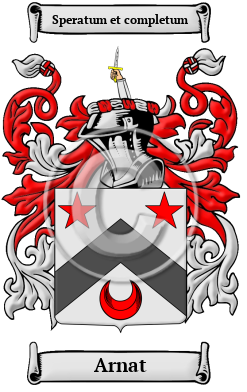
| ![Show Contents]() Arnat History, Family Crest & Coats of Arms Arnat History, Family Crest & Coats of Arms
Etymology of ArnatWhat does the name Arnat mean? The Arnat family saga is rooted in the people of the Pictish Clan of ancient Scotland. The Arnat family lived in the lands of Arnott in the parish of Portmoak in Kinross (now part of the region of Tayside), where one of the first times the name was listed was in 1150 when Michael de Arnoth was mentioned. Early Origins of the Arnat familyThe surname Arnat was first found in the lands of Arnott in the parish of Portmoak, Kinross-shire. The first chief, recorded, Michael Arnott, held those lands about 1150. David, of Fifeshire, his successor was recorded in 1296 when he paid homage to King Edward 1st of England. Early History of the Arnat familyThis web page shows only a small excerpt of our Arnat research. Another 137 words (10 lines of text) covering the years 1320, 1400, 1497, 1498, 1502, 1536, 1600, 1608, 1639, 1652, 1680, 1693, 1743, 1744, 1769, 1890 and 1918 are included under the topic Early Arnat History in all our PDF Extended History products and printed products wherever possible. Arnat Spelling VariationsPrior to the invention of the printing press in the last hundred years, documents were basically unique. Names were written according to sound, and often appeared differently each time they were recorded. Spelling variations of the name Arnat include Arnott, Arnot, Arnatt, Arnocht, Arnote, Arnett, Anetts, Arnette, Ernot, Ernott, Annett, Annetts and many more. Early Notables of the Arnat familyDavid Arnot, C.R.S.A., (fl. 1497- c. 1536), Scottish canon regular and bishop from Arnot, Fife, Rector of Kirkforthar, Fife in 1497, Archdeacon of Lothian in 1498; Sir Michael Arnot, 1st Baronet (d. c. 1680) of Arnot in the County of Fife; and his son, Charles Arnot (d. before 1652) represented Kinross in the Scottish Parliament.
Further to the south in England, Peter Annet (1693-1769), was a deistical writer, and said to have...
Another 70 words (5 lines of text) are included under the topic Early Arnat Notables in all our PDF Extended History products and printed products wherever possible. Migration of the Arnat family to IrelandSome of the Arnat family moved to Ireland, but this topic is not covered in this excerpt.
Another 88 words (6 lines of text) about their life in Ireland is included in all our PDF Extended History products and printed products wherever possible.
| Arnat migration to the United States | + |
The freedom of the North American colonies was enticing, and many Scots left to make the great crossing. It was a long and hard journey, but its reward was a place where there was more land than people and tolerance was far easier to come by. Many of these people came together to fight for a new nation in the American War of Independence, while others remained loyal to the old order as United Empire Loyalists. The ancestors of Scots in North America have recovered much of this heritage in the 20th century through Clan societies and other such organizations. A search of immigration and passenger lists revealed many important and early immigrants to North America bearing the name of Arnat:
Arnat Settlers in United States in the 19th Century- Hugh Arnat, aged 43, who landed in New York in 1812 1
- Juan Arnat, aged 26, who arrived in New Orleans, La in 1846 1
- Marius Arnat, aged 40, who landed in New Orleans, La in 1860 1
The motto was originally a war cry or slogan. Mottoes first began to be shown with arms in the 14th and 15th centuries, but were not in general use until the 17th century. Thus the oldest coats of arms generally do not include a motto. Mottoes seldom form part of the grant of arms: Under most heraldic authorities, a motto is an optional component of the coat of arms, and can be added to or changed at will; many families have chosen not to display a motto.
Motto: Speratum et completum
Motto Translation: Hoped for and Fulfilled.
- Filby, P. William, Meyer, Mary K., Passenger and immigration lists index : a guide to published arrival records of about 500,000 passengers who came to the United States and Canada in the seventeenth, eighteenth, and nineteenth centuries. 1982-1985 Cumulated Supplements in Four Volumes Detroit, Mich. : Gale Research Co., 1985, Print (ISBN 0-8103-1795-8)
 |