| ![Show Contents]() Allmark History, Family Crest & Coats of Arms Allmark History, Family Crest & Coats of Arms
Etymology of AllmarkWhat does the name Allmark mean? The name Allmark was first used by the ancient Strathclyde-Briton people of the Scottish/English Borderlands. The first Allmark to use this name no doubt lived in "Argyleshire, who transposed the syllables of his name on coming to the South (England). Most if not all the existing hearers of this singular patronymic descend from a Richard Almoke, of Yorkshire, whose curious will, with that of his son John is printed in Arch. Journ, v. 316. In 34 and 35, Hen. VIII., this Richard is written Awmoke, and still later Hawmoke." 1 Another source claims the family is from "Almeneches, a location name in Normandy (?) There is a tradition that a Scotchman, coming to London, changed his name from MacAll to Allmack! It may be so." 2 Early Origins of the Allmark familyThe surname Allmark was first found in Dumfriesshire (Gaelic: Siorrachd Dhùn Phris), a Southern area, bordering on England that today forms part of the Dumfries and Galloway Council Area, where this curious name is descended from Robert M'Kawele, Lord of Karsneloughe, who was living in 1370 in Guffok land in Nithsdale. 3 Traditionally within the family name, the first Allmack or Allmark was a MacAll who on migrating south to Yorkshire found it more fashionable to drop the Mac from his name to become accepted in the English society. Progressively the name became Allmack, Allmark, Allmoke, Hawmoke. William Allmack, "one of the founders of the city of Victoria in that Colony (Hong Kong) was honored by Almack Place in that city. He died on his voyage from China in 1846. The Almack motto, based upon the supposed Scottish extraction of the race, is MACK AL SICKER." 1 Early History of the Allmark familyThis web page shows only a small excerpt of our Allmark research. Another 135 words (10 lines of text) covering the years 1500 and 1846 are included under the topic Early Allmark History in all our PDF Extended History products and printed products wherever possible. Allmark Spelling VariationsScribes in Medieval Scotland spelled names by sound rather than any set of rules, so an enormous number of spelling variations exist in names of that era. Allmark has been spelled Allmark, Almark, Allmoke, Hawmoke, Hallmark, Allmack, Aulmark and many more. Early Notables of the Allmark family- William Allmark of Yorkshire
Migration of the Allmark family to IrelandSome of the Allmark family moved to Ireland, but this topic is not covered in this excerpt. More information about their life in Ireland is included in all our PDF Extended History products and printed products wherever possible.
| Allmark migration to the United States | + |
The number of Strathclyde Clan families sailing for North America increased steadily as the persecution continued. In the colonies, they could find not only freedom from the iron hand of the English government, but land to settle on. The American War of Independence allowed many of these settlers to prove their independence, while some chose to go to Canada as United Empire Loyalists. Scots played essential roles in the forging of both great nations. Among them:
Allmark Settlers in United States in the 19th Century- Charles Allmark, aged 22, who landed in America from N. Chester, in 1892
Allmark Settlers in United States in the 20th Century- Charles Allmark, aged 40, who immigrated to the United States, in 1909
- Delie Allmark, aged 55, who settled in America, in 1910
- Ada Allmark, aged 32, who landed in America from Southwick, England, in 1912
| Allmark migration to New Zealand | + |
Emigration to New Zealand followed in the footsteps of the European explorers, such as Captain Cook (1769-70): first came sealers, whalers, missionaries, and traders. By 1838, the British New Zealand Company had begun buying land from the Maori tribes, and selling it to settlers, and, after the Treaty of Waitangi in 1840, many British families set out on the arduous six month journey from Britain to Aotearoa to start a new life. Early immigrants include: Allmark Settlers in New Zealand in the 19th Century- Mary Allmark, aged 18, who arrived in Wellington, New Zealand aboard the ship "Jessie Readman" in 1872 4
- Miss Mary Allmark, (b. 1854), aged 18, British settler travelling from London aboard the ship "Jessie Readman" arriving in Wellington, New Zealand on 14th December 1872 4
| Allmark migration to West Indies | + |
The British first settled the British West Indies around 1604. They made many attempts but failed in some to establish settlements on the Islands including Saint Lucia and Grenada. By 1627 they had managed to establish settlements on St. Kitts (St. Christopher) and Barbados, but by 1641 the Spanish had moved in and destroyed some of these including those at Providence Island. The British continued to expand the settlements including setting the First Federation in the British West Indies by 1674; some of the islands include Barbados, Bermuda, Cayman Island, Turks and Caicos, Jamaica and Belize then known as British Honduras. By the 1960's many of the islands became independent after the West Indies Federation which existed from 1958 to 1962 failed due to internal political conflicts. After this a number of Eastern Caribbean islands formed a free association. 5Allmark Settlers in West Indies in the 18th Century- Thomas Allmark who settled in Barbados in 1780
| Contemporary Notables of the name Allmark (post 1700) | + |
- Benjamin Graydon Allmark (1911-2004), Canadian politician from Kingston, Ontario
- Dean Allmark (b. 1985), English professional wrestler
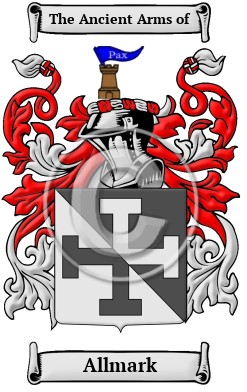
The motto was originally a war cry or slogan. Mottoes first began to be shown with arms in the 14th and 15th centuries, but were not in general use until the 17th century. Thus the oldest coats of arms generally do not include a motto. Mottoes seldom form part of the grant of arms: Under most heraldic authorities, a motto is an optional component of the coat of arms, and can be added to or changed at will; many families have chosen not to display a motto.
Motto: MACK AL SICKER
- Lower, Mark Anthony, Patronymica Britannica, A Dictionary of Family Names of the United Kingdom. London: John Russel Smith, 1860. Print.
- Barber, Henry, British Family Names London: Elliot Stock, 62 Paternoster Row, 1894. Print.
- Black, George F., The Surnames of Scotland Their Origin, Meaning and History. New York: New York Public Library, 1946. Print. (ISBN 0-87104-172-3)
- New Zealand Yesteryears Passenger Lists 1800 to 1900 (Retrieved 17th October 2018). Retrieved from http://www.yesteryears.co.nz/shipping/passlist.html
- https://en.wikipedia.org/wiki/British_West_Indies
 |