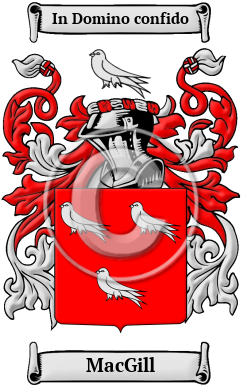
| ![Show Contents]() MacGill History, Family Crest & Coats of Arms MacGill History, Family Crest & Coats of Arms
Etymology of MacGillWhat does the name MacGill mean? This name is derived from either the Scottish Gaelic "Mac Gille," or the Irish Gaelic "Mac Giolla." In either case, the name was thought to be created from the occupation of being a servant. Early Origins of the MacGill familyThe surname MacGill was first found in Galloway (Gaelic: Gall-ghaidhealaibh), an area of southwestern Scotland, now part of the Council Area of Dumfries and Galloway, that formerly consisted of the counties of Wigtown (West Galloway) and Kirkcudbright (East Galloway), where they held a family seat from early times and their first records appeared on the early census rolls taken by the early Kings of Britain to determine the rate of taxation of their subjects. Early History of the MacGill familyThis web page shows only a small excerpt of our MacGill research. Another 91 words (6 lines of text) covering the years 1231, 1639, 1653, 1692, 1693, 1700, 1806, 1816, 1854, 1855, 1865, 1866, 1870 and 1898 are included under the topic Early MacGill History in all our PDF Extended History products and printed products wherever possible. MacGill Spelling VariationsSpelling variations of this family name include: MacGill, Magill, Makgill and others. Early Notables of the MacGill familyFather Hugh MacGoill, O.P., of the convent of Rathmore. He was hanged at Waterford in 1653, one of the many Catholic martyrs of the seventeenth century.
Sir John Magill, 1st Baronet (1639-1700) was an Anglo-Irish politician, Member of Parliament for Hillsborough (1692-1693.) Juliette Augusta Magill...
Another 44 words (3 lines of text) are included under the topic Early MacGill Notables in all our PDF Extended History products and printed products wherever possible. Migration of the MacGill family to IrelandSome of the MacGill family moved to Ireland, but this topic is not covered in this excerpt. More information about their life in Ireland is included in all our PDF Extended History products and printed products wherever possible.
| MacGill migration to the United States | + |
MacGill Settlers in United States in the 18th Century- James Macgill, who landed in Maryland in 1730 1
- Patrick MacGill, who settled in Charles Town [Charleston], South Carolina with Richard, Samuel and William, in 1767
- Andrew MacGill, who settled in Virginia in 1774
MacGill Settlers in United States in the 19th Century- Anthony MacGill, who arrived in Baltimore, Maryland in 1811 1
- Robert MacGill, who arrived in New York, NY in 1816 1
- Daniel, Hugh, James, John, Patrick, Samuel, and William MacGill all, who arrived in Philadelphia between 1840 and 1860
| Contemporary Notables of the name MacGill (post 1700) | + |
- Elizabeth Muriel Gregory "Elsie" MacGill OC (1905-1980), Canadian world's first female aircraft designer, known as the "Queen of the Hurricanes", immortalized on a limited edition dollar coin in 2023
- Gillis MacGill (1928-2013), American fashion model who opened her own modelling agency, Mannequin, in November 1960
- James MacGill (1912-1993), American jurist, descendant of James McGill, the rector for Christ Church Guilford, appointed in 1730
- Peter MacGill, American gallerist and curator, current director of the Pace/MacGill Gallery, New York
- William MacGill (1922-1997), American educator and psychology professor
- Patrick MacGill (1889-1963), Irish journalist, poet and novelist, known as "The Navvy Poet"
- Moyna Macgill (1895-1975), born Charlotte Lillian McIldowie, Irish stage and film actress and the mother of actress Angela Lansbury
- Terence Mornington David "Terry" MacGill (b. 1945), Australian former cricketer
- Stuart Charles Glyndwr MacGill (b. 1971), former Australian cricketer, who played 44 Tests and 3 ODIs
- ... (Another 1 notables are available in all our PDF Extended History products and printed products wherever possible.)
The motto was originally a war cry or slogan. Mottoes first began to be shown with arms in the 14th and 15th centuries, but were not in general use until the 17th century. Thus the oldest coats of arms generally do not include a motto. Mottoes seldom form part of the grant of arms: Under most heraldic authorities, a motto is an optional component of the coat of arms, and can be added to or changed at will; many families have chosen not to display a motto.
Motto: In Domino confido
Motto Translation: I trust in the Lord.
- Filby, P. William, Meyer, Mary K., Passenger and immigration lists index : a guide to published arrival records of about 500,000 passengers who came to the United States and Canada in the seventeenth, eighteenth, and nineteenth centuries. 1982-1985 Cumulated Supplements in Four Volumes Detroit, Mich. : Gale Research Co., 1985, Print (ISBN 0-8103-1795-8)
 |