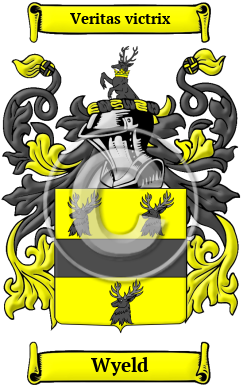
| ![Show Contents]() Wyeld History, Family Crest & Coats of Arms Wyeld History, Family Crest & Coats of Arms
Etymology of WyeldWhat does the name Wyeld mean? The ancient Norman culture that was established in England after the Conquest of 1066 produced the name of Wyeld. It was given to a person of wild or undisciplined character. Looking back even further, we found the name was originally derived from the Old English word wilde, meaning untamed or uncivilized. Early Origins of the Wyeld familyThe surname Wyeld was first found in Berkshire where they held a family seat as Lords of the manor of Wyld Court, being descended from Ulric Wilde, a Domesday tenant in that county. Early History of the Wyeld familyThis web page shows only a small excerpt of our Wyeld research. Another 73 words (5 lines of text) covering the years 1590, 1609, 1610, 1611, 1647, 1648, 1659, 1660, 1665, 1669, 1679, 1682, 1683 and 1725 are included under the topic Early Wyeld History in all our PDF Extended History products and printed products wherever possible. Wyeld Spelling VariationsMultitudes of spelling variations are a hallmark of Anglo Norman names. Most of these names evolved in the 11th and 12th century, in the time after the Normans introduced their own Norman French language into a country where Old and Middle English had no spelling rules and the languages of the court were French and Latin. To make matters worse, medieval scribes spelled words according to sound, so names frequently appeared differently in the various documents in which they were recorded. The name was spelled Wild, Wilde, Wildee, Wylde and others. Early Notables of the Wyeld familyJohn Wilde or Wylde (1590-1669), Chief Baron of the exchequer, son and heir of George Wylde of Kempsey, Worcestershire, Serjeant-at-Law. 1
George Wild or Wilde (1610-1665), Bishop of Derry, born 9 Jan. 1609, the son of Henry Wild, a citizen of London. "When the civil war broke out he became preacher to the king at Oxford, and the degree of D.C.L. was conferred on him on 23 Nov. 1647. He was turned out of his fellowship by the parliamentary visitors in 1648, and was sequestered from his living at Biddenden, but continued to officiate wherever he could during the Commonwealth. After the...
Another 168 words (12 lines of text) are included under the topic Early Wyeld Notables in all our PDF Extended History products and printed products wherever possible. Migration of the Wyeld family to IrelandSome of the Wyeld family moved to Ireland, but this topic is not covered in this excerpt.
Another 31 words (2 lines of text) about their life in Ireland is included in all our PDF Extended History products and printed products wherever possible. Migration of the Wyeld familyBecause of this political and religious unrest within English society, many people decided to immigrate to the colonies. Families left for Ireland, North America, and Australia in enormous numbers, traveling at high cost in extremely inhospitable conditions. The New World in particular was a desirable destination, but the long voyage caused many to arrive sick and starving. Those who made it, though, were welcomed by opportunities far greater than they had known at home in England. Many of these families went on to make important contributions to the emerging nations of Canada and the United States. Analysis of immigration records indicates that some of the first North American immigrants bore the name Wyeld or a variant listed above: Robert Wild who settled in Virginia in 1635; William, John and Jo Wild, who all settled in Boston Massachusetts in 1635; John Wild, who settled in Barbados in 1654.
The motto was originally a war cry or slogan. Mottoes first began to be shown with arms in the 14th and 15th centuries, but were not in general use until the 17th century. Thus the oldest coats of arms generally do not include a motto. Mottoes seldom form part of the grant of arms: Under most heraldic authorities, a motto is an optional component of the coat of arms, and can be added to or changed at will; many families have chosen not to display a motto.
Motto: Veritas victrix
Motto Translation: Truth Conquered.
- Smith, George (ed), Dictionary of National Biography. London: Smith, Elder & Co., 1885-1900. Print
 |