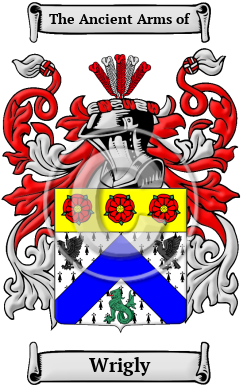
| ![Show Contents]() Wrigly History, Family Crest & Coats of Arms Wrigly History, Family Crest & Coats of Arms
- Origins Available:
England
Etymology of WriglyWhat does the name Wrigly mean? The history of the Wrigly family goes back to the ancient Anglo-Saxon culture of Britain. It is derived from the family living in a settlement called Wrigley, which experts theorize was in the West Riding of Yorkshire. The surname Wrigly belongs to the large category of Anglo-Saxon habitation names, which are derived from pre-existing names for towns, villages, parishes, or farmsteads. Early Origins of the Wrigly familyThe surname Wrigly was first found in Wrigley Head, now part of Failsworth in Greater Manchester. 1 "This name seems to have passed over the borders from the West Riding of Yorkshire into South-East Lancashire, via Saddleworth, in which district it still possesses a strong foothold." 2 Ironically, the first record of the family was not Saddleworth, but in Derbyshire where Wills de Wriggeley was listed at Brampton, near Chesterfield in 1327-1328 as per the Lay Subsidy Rolls. Here the family held estates well into the 16th century as in 1556 Ralph Wrigly was appointed priest at Kirk Langley, by Henry Pole, Lord of the Manor. Through the years the family continued to be quite evident in Longford, west of Derby. Roger Wrigley was a priest at Prestwich in 1549 and curate at Oldham (1563-1575.) The Yorkshire Poll Tax Rolls of 1379 has only one entry for the family, that of Willelmus Wryglegh; but the source Wills at Chester, has the following: John Wrgley, of Millington, 1576; John Wrigley, of Saddleworth, 1620; and Margaret Wrigley, of Saddleworth, 1635. 2 The American "Chewing Gum" Wrigleys trace back to Broadhead, Broadmeadow and Knowl, Yorkshire c. 1681. Early History of the Wrigly familyThis web page shows only a small excerpt of our Wrigly research. Another 124 words (9 lines of text) covering the years 1524, 1539, 1543, 1766, 1808, 1832, 1833, 1842, 1861, 1909 and 1932 are included under the topic Early Wrigly History in all our PDF Extended History products and printed products wherever possible. Wrigly Spelling VariationsUntil quite recently, the English language has lacked a definite system of spelling rules. Consequently, Anglo-Saxon surnames are characterized by a multitude of spelling variations. Changes in Anglo-Saxon names were influenced by the evolution of the English language, as it incorporated elements of French, Latin, and other languages. Although Medieval scribes and church officials recorded names as they sounded, so it is common to find one person referred to by several different spellings of his surname, even the most literate people varied the spelling of their own names. Variations of the name Wrigly include Wrigley, Wrigly, Rigley, Riggeley and others. Early Notables of the Wrigly familyMore information is included under the topic Early Wrigly Notables in all our PDF Extended History products and printed products wherever possible. Migration of the Wrigly familySearching for a better life, many English families migrated to British colonies. Unfortunately, the majority of them traveled under extremely harsh conditions: overcrowding on the ships caused the majority of the immigrants to arrive diseased, famished, and destitute from the long journey across the ocean. For those families that arrived safely, modest prosperity was attainable, and many went on to make invaluable contributions to the development of the cultures of the new colonies. Research into the origins of individual families in North America revealed records of the immigration of a number of people bearing the name Wrigly or a variant listed above: Abraham, Elias, James, John, Joseph, Thomas, William Wrigley, all arrived in Philadelphia between 1825-1868.
- Reaney, P.H and R.M. Wilson, A Dictionary of English Surnames. London: Routledge, 1991. Print. (ISBN 0-415-05737-X)
- Bardsley, C.W, A Dictionary of English and Welsh Surnames: With Special American Instances. Wiltshire: Heraldry Today, 1901. Print. (ISBN 0-900455-44-6)
 |