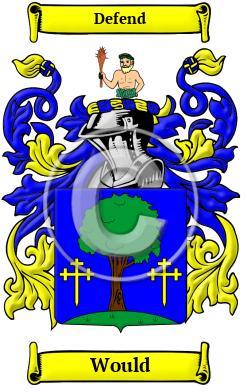
| ![Show Contents]() Would History, Family Crest & Coats of Arms Would History, Family Crest & Coats of Arms
Etymology of WouldWhat does the name Would mean? The Would surname is derived from the Middle English word "wode," meaning "wood," which suggests that the original bearer of the name lived near a wood, or was perhaps employed as a woodcutter or forester. Early Origins of the Would familyThe surname Would was first found in Leicestershire, England. However, during ascension of William to the English throne, the family were stripped of their land holdings in Leicestershire by the king, and moved north to Dumfriesshire, Scotland. The first of the family in this region are said to descend from a Norman knight by the name of Ernald de Bosco (Bosco is a Latinized form of wood,) who accompanied William the Conqueror. A number of Boscos are thought to have have moved northwards with other Anglo-Norman families in the train of Margaret, King Malcolm Ceanmore's second wife, to escape the ponderous rule of William. Early History of the Would familyThis web page shows only a small excerpt of our Would research. Another 194 words (14 lines of text) covering the years 1124, 1153, 1168, 1214, 1295, 1376, 1398, 1488, 1515, 1678, 1680, 1688, 1695, 1761 and 1890 are included under the topic Early Would History in all our PDF Extended History products and printed products wherever possible. Would Spelling VariationsSpelling variations of this family name include: Vould, Voud, Vode, Would, Wood, Woods, Wode, Woid, Wodes and many more. Early Notables of the Would familySir Andrew Wood (d. 1515) of Largo, Fife, a Scottish Sea Captain, who rose to become Lord High Admiral of Scotland, he held the lands at Kirkton of Largo in Fife, and is said to be the scion of the Chiefly line of the Woods. Family lore suggests that he may have transported James III...
Another 55 words (4 lines of text) are included under the topic Early Would Notables in all our PDF Extended History products and printed products wherever possible. Migration of the Would family to IrelandSome of the Would family moved to Ireland, but this topic is not covered in this excerpt.
Another 70 words (5 lines of text) about their life in Ireland is included in all our PDF Extended History products and printed products wherever possible.
| Would migration to the United States | + |
Would Settlers in United States in the 17th Century- Margett Would, who arrived in Virginia in 1664 1
The motto was originally a war cry or slogan. Mottoes first began to be shown with arms in the 14th and 15th centuries, but were not in general use until the 17th century. Thus the oldest coats of arms generally do not include a motto. Mottoes seldom form part of the grant of arms: Under most heraldic authorities, a motto is an optional component of the coat of arms, and can be added to or changed at will; many families have chosen not to display a motto.
Motto: Defend
- Filby, P. William, Meyer, Mary K., Passenger and immigration lists index : a guide to published arrival records of about 500,000 passengers who came to the United States and Canada in the seventeenth, eighteenth, and nineteenth centuries. 1982-1985 Cumulated Supplements in Four Volumes Detroit, Mich. : Gale Research Co., 1985, Print (ISBN 0-8103-1795-8)
 |