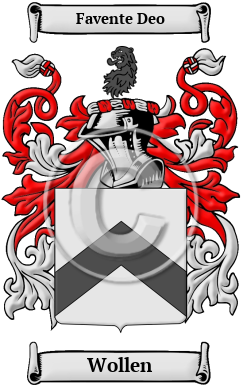
| ![Show Contents]() Wollen History, Family Crest & Coats of Arms Wollen History, Family Crest & Coats of Arms
Early Origins of the Wollen familyThe surname Wollen was first found in Cambridgeshire where they held a family seat. The Saxon influence of English history diminished after the Battle of Hastings in 1066. The language of the courts was French for the next three centuries and the Norman ambience prevailed. But Saxon surnames survived and the family name was first referenced in the year 1235 when they held estates in Hertfordshire, the original spelling as Woulond. Early History of the Wollen familyThis web page shows only a small excerpt of our Wollen research. Another 86 words (6 lines of text) covering the years 1455 and 1487 are included under the topic Early Wollen History in all our PDF Extended History products and printed products wherever possible. Wollen Spelling VariationsSpelling variations of this family name include: Woolland, Woollan, Woollon, Woollons, Wollen, Woollens, Wollan, Woollam, Wolin, Woolham, Woollams, Woolham, Woollham, Wollensbrook and many more. Early Notables of the Wollen familyMore information is included under the topic Early Wollen Notables in all our PDF Extended History products and printed products wherever possible.
| Wollen migration to the United States | + |
Wollen Settlers in United States in the 18th Century- Thomas Wollen, who arrived in Virginia in 1716 1
| Wollen migration to New Zealand | + |
Emigration to New Zealand followed in the footsteps of the European explorers, such as Captain Cook (1769-70): first came sealers, whalers, missionaries, and traders. By 1838, the British New Zealand Company had begun buying land from the Maori tribes, and selling it to settlers, and, after the Treaty of Waitangi in 1840, many British families set out on the arduous six month journey from Britain to Aotearoa to start a new life. Early immigrants include: Wollen Settlers in New Zealand in the 19th Century- Mr. David Wollen, (b. 1849), aged 21, Cornish farm labourer departing on 23rd September 1870 aboard the ship "Zealandia" arriving in Lyttelton, Canterbury, New Zealand on 23rd December 1870 2
| Contemporary Notables of the name Wollen (post 1700) | + |
- Peter Wollen (b. 1938), English political journalist and film theorist
- Sir Ernest Wollen, Australia politician
The motto was originally a war cry or slogan. Mottoes first began to be shown with arms in the 14th and 15th centuries, but were not in general use until the 17th century. Thus the oldest coats of arms generally do not include a motto. Mottoes seldom form part of the grant of arms: Under most heraldic authorities, a motto is an optional component of the coat of arms, and can be added to or changed at will; many families have chosen not to display a motto.
Motto: Favente Deo
Motto Translation: I will defend my God.
- Filby, P. William, Meyer, Mary K., Passenger and immigration lists index : a guide to published arrival records of about 500,000 passengers who came to the United States and Canada in the seventeenth, eighteenth, and nineteenth centuries. 1982-1985 Cumulated Supplements in Four Volumes Detroit, Mich. : Gale Research Co., 1985, Print (ISBN 0-8103-1795-8)
- Cornwall Online Parish Clerks. (Retrieved 2018, April 30). Emigrants to Lyttelton 1858-84 [PDF]. Retrieved from http://www.opc-cornwall.org/Resc/pdfs/new_zealand_assisted.pdf
 |