| ![Show Contents]() Wildermoth History, Family Crest & Coats of Arms Wildermoth History, Family Crest & Coats of Arms
- Origins Available:
England
Etymology of WildermothWhat does the name Wildermoth mean? The name Wildermoth has multiple possible origins. Harrison notes the name "represents the common Anglo-Saxon personal name Wealdhere = Mighty Army [Old English ge)weald, power, might + here, army]." 1 Smith notes the name denotes "dweller in a forest; descendant of Wealdhere." 2 Arthur claims the name denotes "represents the common Anglo-Saxon personal name Wealdhere." 3 And Reaney believes the name is from the Old English word "wildeor" meaning "wild animal." 4 Early Origins of the Wildermoth familyThe surname Wildermoth was first found in Derbyshire where William Wilder, Wyldere was listed in the Subsidy Rolls of 1327. 4 Wilder is an old Reading [Berkshire] name; William Wilder was mayor in 1651, and a second William Wilder held this office in 1714. The name is still in the town." 5 Early History of the Wildermoth familyThis web page shows only a small excerpt of our Wildermoth research. Another 71 words (5 lines of text) covering the year 1450 is included under the topic Early Wildermoth History in all our PDF Extended History products and printed products wherever possible. Wildermoth Spelling VariationsSpelling variations of this family name include: Wilder, Wylder, Wilde and others. Early Notables of the Wildermoth familyMore information is included under the topic Early Wildermoth Notables in all our PDF Extended History products and printed products wherever possible.
| Wildermoth migration to New Zealand | + |
Emigration to New Zealand followed in the footsteps of the European explorers, such as Captain Cook (1769-70): first came sealers, whalers, missionaries, and traders. By 1838, the British New Zealand Company had begun buying land from the Maori tribes, and selling it to settlers, and, after the Treaty of Waitangi in 1840, many British families set out on the arduous six month journey from Britain to Aotearoa to start a new life. Early immigrants include: Wildermoth Settlers in New Zealand in the 19th Century- Mr. John Wildermoth, (b. 1828), aged 33, English farm labourer, from Devon travelling from London aboard the ship "Royal Stuart" arriving in Lyttlelton, Christchurch, South Island, New Zealand on 8th October 1861 6
- Mrs. Sarah Wildermoth, (b. 1839), aged 22, English settler, from Devon travelling from London aboard the ship "Royal Stuart" arriving in Lyttlelton, Christchurch, South Island, New Zealand on 8th October 1861 6
- Mr. William Alex. Wildermoth, (b. 1859), aged 2, English settler, from Devon travelling from London aboard the ship "Royal Stuart" arriving in Lyttlelton, Christchurch, South Island, New Zealand on 8th October 1861 6
- Mr. John James Wildermoth, (b. 1860), aged 1, English settler, from Devon travelling from London aboard the ship "Royal Stuart" arriving in Lyttlelton, Christchurch, South Island, New Zealand on 8th October 1861 6
| Contemporary Notables of the name Wildermoth (post 1700) | + |
- Michael Joseph Wildermoth (b. 1864), New Zealand constable, mentioned in the Australasian Biographical Archive
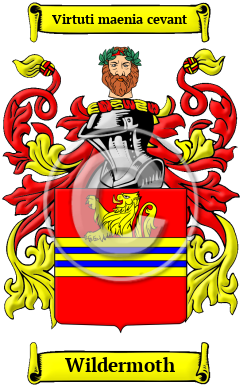
The motto was originally a war cry or slogan. Mottoes first began to be shown with arms in the 14th and 15th centuries, but were not in general use until the 17th century. Thus the oldest coats of arms generally do not include a motto. Mottoes seldom form part of the grant of arms: Under most heraldic authorities, a motto is an optional component of the coat of arms, and can be added to or changed at will; many families have chosen not to display a motto.
Motto: Virtuti maenia cevant
Motto Translation: Let walls yield to valour.
- Harrison, Henry, Surnames of the United Kingdom: A Concise Etymological Dictionary Baltimore: Geneological Publishing Company, 2013. Print
- Smith, Eldson Coles, New Dictionary of American Family Names New York: Harper & Row, 1956. Print
- Arthur, William , An Etymological Dictionary of Family and Christian Names. London: 1857. Print
- Reaney, P.H and R.M. Wilson, A Dictionary of English Surnames. London: Routledge, 1991. Print. (ISBN 0-415-05737-X)
- Guppy, Henry Brougham, Homes of Family Names in Great Britain. 1890. Print.
- New Zealand Yesteryears Passenger Lists 1800 to 1900 (Retrieved 26th March 2019). Retrieved from http://www.yesteryears.co.nz/shipping/passlist.html
 |