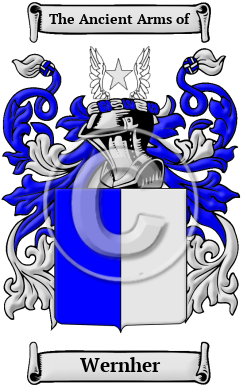
| ![Show Contents]() Wernher History, Family Crest & Coats of Arms Wernher History, Family Crest & Coats of Arms
- Origins Available:
Germany
Etymology of WernherWhat does the name Wernher mean? The German surname Wernher emerged in the lands that formed the modern state of Lower Saxony, which is presently bordered by the North Sea, the Hartz mountains and the Elbe and Ems rivers. Lower Saxony was previously a medieval Saxon dukedom. The name can be traced to the popular medieval pet-form Wezelo, which was a common abbreviation of the Christian name Wernher, and the surname came to denote 'a son of Wezelo'. Wernher was a very popular choice of Christian name in Medieval Germany, as it had been the name of many famous Crusaders. This Christian name was popular among their ranks and this ensured the popularity of the name. Most personal names were abbreviated and Wezelo was a common abbreviation of Wernher. The name Werner translates from German to mean "protector." Bruder (Brother) Wernher (fl. 13th century) was an Austrian poet who wrote Middle High German social or political songs. He took part in the Sixth Crusade (1228-1229) under Emperor Frederick II as in one poem, he was highly critical of Pope Gregory IX for the war he instigated against Frederick II in 1228. Wernher von Homberg (also Werner; Hohenberg, 1284-1320) was a knight in the service Emperor Henry VII, and later of Frederick the Fair. Some of his poems appear in the Codex Manesse (c. 1340.) Early Origins of the Wernher familyThe surname Wernher was first found in Lower Saxony, where the family gained a significant reputation for their contribution to the emerging mediaeval society. Branches of this estimable family held estates near Hanover, at Trebitsch in Silesia, and at Tolitz in Pomerania. The oldest form of the name is Werneke or Werner, but, in northern areas especially around Hamburg, it changed to Warner by around 1300. Chronicles first mention Herman Werneking of Hanover in 1497. Early History of the Wernher familyThis web page shows only a small excerpt of our Wernher research. Another 189 words (14 lines of text) covering the years 1490, 1541, 1637, 1646, 1687, 1693, 1710, 1718, 1750, 1759, 1761, 1766, 1768, 1791, 1805, 1817, 1818, 1823 and 1829 are included under the topic Early Wernher History in all our PDF Extended History products and printed products wherever possible. Wernher Spelling VariationsSpelling variations of this family name include: Werner, Wernher, Warner, Warners, Werners, Wernere, Wernerer, Waerner, Warncke, Warnke (Hamburg), Werneke, Warnken, Warnke, Warneking (Westphalia) and many more. Early Notables of the Wernher family- Zacharias Werner (1768-1823), who was a controversial dramatist. Abraham Gottlieb Werner (1750-1817) was a famous mineralogist and is considered to be the founder of geology. He influenced generations...
Migration of the Wernher familySome of the first settlers of this family name or some of its variants were: Christoff Werner, who emigrated to England or America with his wife and son in 1709; Christopher Werner arrived in New York State in 1710 at the age of 35.
| Contemporary Notables of the name Wernher (post 1700) | + |
- Sir Julius Charles Wernher (1850-1912), 1st Baronet of Luton Hoo Park in the Parish of Luton, Bedford, German-born Randlord and art collector
- Sir Derrick Wernher (1889-1948), 2nd Baronet of Luton Hoo Park in the Parish of Luton, Bedford, British peer, a leading personality in American bridge, eponym of the Wernher trophy and the Wernher Open Pairs Championship
- Lady Anastasia Mikhailovna Wernher CBE (1892-1977), née Countess Anastasia Mikhailovna de Torby, a German-born Russian-British aristocrat and thoroughbred racehorse owner
- Georgina Wernher (1919-2011), birth name of Lady Kennard, a British aristocrat who was considered "one of the best connected women in the country"
- Major-General Sir Harold Wernher (1893-1973), 3rd Baronet of Luton Hoo Park in the Parish of Luton, Bedford, British military officer, second son of Sir Julius Wernher, 1st Baronet
- Wernher von Braun (1912-1977), German scientist, formerly involved in the German missile program, father of the U.S. space program, director of the Marshal Space Flight Centre (1960-70), developed the Saturn rocket
 |