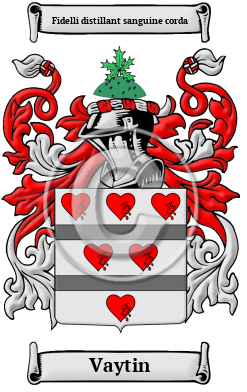
| ![Show Contents]() Vaytin History, Family Crest & Coats of Arms Vaytin History, Family Crest & Coats of Arms
- Origins Available:
England
Etymology of VaytinWhat does the name Vaytin mean? The ancestors of the Vaytin surname lived among the Anglo-Saxon tribes of Britain. As a surname, Vaytin may have derived from a few sources. There was an Old Norse personal name "Faerthegn," which meant "a traveling warrior" or "Thane (Lord)," a mercenary who led a band of warriors and settled local disputes. 1 The "Farthing" denomination of English coinage dates back to the Old English "feorthing," which was a quarter of a penny. In this instance, Vaytin may have been a nickname for someone who paid this amount in rent. Early Origins of the Vaytin familyThe surname Vaytin was first found in Devon where this ancient Anglo-Saxon name was derived from the name Faerthegn and, immediately before the Norman Conquest as Farthein. The name was recorded in the Domesday Book in 1086 as Fardan or Fardein. 2 3 An extensive search of early rolls revealed Geoffrey Ferthing, recorded in the Hundredorum Rolls of 1273; William Ferthing, listed in the Writs of Parliament for 1300; Richard Ferthing in the Close Rolls, 18 Edward I (during the eighteenth year of King Edward I's reign); and Robertus Farthing listed in the Yorkshire Poll Tax Rolls of 1379. 4 The name could have originated in Faringdon, Berkshire where Thomas Fartheyn (1311), Thomas Fardeyn (1330) and Thomas Farendyn (1323) were all listed in the Writs of Parliament. The three entries above refer to one individual. 4 Early History of the Vaytin familyThis web page shows only a small excerpt of our Vaytin research. Another 46 words (3 lines of text) covering the years 1700, 1723, 1736, 1743, 1782, 1786, 1787, 1801, 1830, 1838 and 1865 are included under the topic Early Vaytin History in all our PDF Extended History products and printed products wherever possible. Vaytin Spelling VariationsBefore English spelling was standardized a few hundred years ago, spelling variations of names were a common occurrence. Elements of Latin, French and other languages became incorporated into English through the Middle Ages, and name spellings changed even among the literate. The variations of the surname Vaytin include Farthing, Fayting, Farthen, Farden, Fardon, Varthing, Vaytin, Fairthing, Fardin, Farthin and many more. Early Notables of the Vaytin familyJohn Fardon I (1700-1743), an English clockmaker was apprenticed to Thomas Gilkes of Sibford Gower and traded in Deddington from about 1723. His only son John Fardon II (1736-1786) was only 10 years old when his father died and seems to have been apprenticed in London. He and his father is buried at Adderbury West...
Another 54 words (4 lines of text) are included under the topic Early Vaytin Notables in all our PDF Extended History products and printed products wherever possible. Migration of the Vaytin familyA great wave of immigration to the New World was the result of the enormous political and religious disarray that struck England at that time. Families left for the New World in extremely large numbers. The long journey was the end of many immigrants and many more arrived sick and starving. Still, those who made it were rewarded with an opportunity far greater than they had known at home in England. These emigrant families went on to make significant contributions to these emerging colonies in which they settled. Some of the first North American settlers carried this name or one of its variants: Robert and Bertha Farthing settled in Virginia in 1637; Edward Farthing settled in Barbados in 1678; George Farthing arrived in Philadelphia in 1808; Cyrus Farthing settled in Herring Neck in Newfoundland in 1871.
The motto was originally a war cry or slogan. Mottoes first began to be shown with arms in the 14th and 15th centuries, but were not in general use until the 17th century. Thus the oldest coats of arms generally do not include a motto. Mottoes seldom form part of the grant of arms: Under most heraldic authorities, a motto is an optional component of the coat of arms, and can be added to or changed at will; many families have chosen not to display a motto.
Motto: Fidelli distillant sanguine corda
- Harrison, Henry, Surnames of the United Kingdom: A Concise Etymological Dictionary Baltimore: Geneological Publishing Company, 2013. Print
- Williams, Dr Ann. And G.H. Martin, Eds., Domesday Book A Complete Translation. London: Penguin, 1992. Print. (ISBN 0-141-00523-8)
- Lower, Mark Anthony, Patronymica Britannica, A Dictionary of Family Names of the United Kingdom. London: John Russel Smith, 1860. Print.
- Bardsley, C.W, A Dictionary of English and Welsh Surnames: With Special American Instances. Wiltshire: Heraldry Today, 1901. Print. (ISBN 0-900455-44-6)
 |