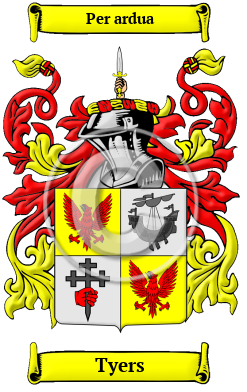
| ![Show Contents]() Tyers History, Family Crest & Coats of Arms Tyers History, Family Crest & Coats of Arms
- Origins Available:
Scotland
Ireland
Etymology of TyersWhat does the name Tyers mean? In the Scotland of ancient times, Tyers was a name for a carpenter or wright. The Gaelic form Mac an t-saoir means son of the carpenter. Most historians agree that their earliest habitations were on MacDonald territories on Kintyre. Most legends about their beginnings point to an origin in the Hebrides. From this point on, opinions differ. One legend has the Clan-an-t-Saor (Children of the Carpenter) arriving in Lorne in a galley with a white cow, another says that the galley, set adrift, developed a leak below the water line and the MacDonald Chieftain placed his thumb in the hole to keep the boat afloat. Spotting help at a distance, he cut off his thumb so that he could wave. He was ironically named the Carpenter or MacIntyre. Some claim that the family derived its name from a member of the MacDonalds who was called Cean-tire because of his ownership of lands on the peninsula of Kintyre. Tyers Coat of Arms CreationThe crest of this clan is a hand holding a dagger, and their motto, " Per Ardua" (Through difficulties), probably because they had success only by hard work. There are two legends as to how they got the name Macintyre. One is that at Creich, in Sutherland, one of the Clan Donald built a fort so well that he became known as "An Saor," Gaelic for "the carpenter," and his son as "Mac-an-shaor," which is pronounced very like Macintyre. The other story is that in coming over from Ireland the plug in the bottom of the boat was displaced and thrown overboard as they were baling. Having nothing handy to stop the in rushing water, the first Macintyre thrust his thumb into the hole, and when he found that his services were urgently needed in another part of the boat, he chopped it off, and the thumbless one was afterwards known as "An Saor." Perhaps it is to commemorate this that they have a galley with sails furled in their armorial bearings. 1 Early Origins of the Tyers familyThe surname Tyers was first found in Argyllshire (Gaelic erra Ghaidheal), the region of western Scotland corresponding roughly with the ancient Kingdom of Dál Riata, in the Strathclyde region of Scotland, now part of the Council Area of Argyll and Bute, where according legend, Maurice or Murdock, The Wright, (c.1150) became the first MacIntyre chief as a reward for helping his uncle, Somerled, King of Argyll and the Western Isles. Early History of the Tyers familyThis web page shows only a small excerpt of our Tyers research. Another 181 words (13 lines of text) covering the years 1543, 1597, 1890, 1955 and 1991 are included under the topic Early Tyers History in all our PDF Extended History products and printed products wherever possible. Tyers Spelling VariationsMedieval spelling was at best an intuitive process, and translation between Gaelic and English was no more effective. These factors caused an enormous number of spelling variations in Dalriadan names. In fact, it was not uncommon to see a father and son who spelled their name differently. Over the years, Tyers has been spelled MacIntyre, MacIntire, MacIntre and many more. Early Notables of the Tyers familyAnother 50 words (4 lines of text) are included under the topic Early Tyers Notables in all our PDF Extended History products and printed products wherever possible. Migration of the Tyers family to IrelandSome of the Tyers family moved to Ireland, but this topic is not covered in this excerpt.
Another 59 words (4 lines of text) about their life in Ireland is included in all our PDF Extended History products and printed products wherever possible.
| Tyers migration to the United States | + |
The hardy Scots who made the crossing settled all along the east coast of North America and in the great west that was just then opening up. At the time of the American War of Independence, many United Empire Loyalists moved north from the American colonies to Canada. Scottish national heritage became better known in North America in the 20th century through highland games and other patriotic events. An examination of immigration records and passenger ship lists revealed that people bearing the name Tyers arrived in North America very early:
Tyers Settlers in United States in the 17th Century- John Tyers, who landed in Virginia in 1623 2
| Tyers migration to Australia | + |
Tyers Settlers in Australia in the 19th Century- William Tyers, aged 24, a labourer, who arrived in South Australia in 1853 aboard the ship "Shackamaxon" 3
| Tyers migration to New Zealand | + |
Emigration to New Zealand followed in the footsteps of the European explorers, such as Captain Cook (1769-70): first came sealers, whalers, missionaries, and traders. By 1838, the British New Zealand Company had begun buying land from the Maori tribes, and selling it to settlers, and, after the Treaty of Waitangi in 1840, many British families set out on the arduous six month journey from Britain to Aotearoa to start a new life. Early immigrants include: Tyers Settlers in New Zealand in the 19th Century- Rose Tyers, aged 23, a housemaid, who arrived in Auckland, New Zealand aboard the ship "Rangitikei" in 1884
| Contemporary Notables of the name Tyers (post 1700) | + |
- Kathy Tyers (b. 1952), American author
- Thomas Tyers (1726-1787), English author, the eldest son of Jonathan Tyers
- Jonathan Tyers (d. 1767), English proprietor of Vauxhall Gardens and later owner of the gardens by purchasing a portion in 1752 for 3,800l
- Captain Charles James Tyers RN, FRSV (1806-1870), English surveyor and explorer, explorer of Australia, eponym of Tyers, Tyers Junction, Western Tyers, Tyers River, Mount Tyers in Australia
| Historic Events for the Tyers family | + |
- Mr. Frederick Charles Tyers, English 2nd Class passenger from Nottingham, England, who sailed aboard the RMS Lusitania (1915) and died in the sinking and was recovered 4
The motto was originally a war cry or slogan. Mottoes first began to be shown with arms in the 14th and 15th centuries, but were not in general use until the 17th century. Thus the oldest coats of arms generally do not include a motto. Mottoes seldom form part of the grant of arms: Under most heraldic authorities, a motto is an optional component of the coat of arms, and can be added to or changed at will; many families have chosen not to display a motto.
Motto: Per ardua
Motto Translation: Through difficulties.
- Polson, Alexander, The Romance of Scottish Crests and Mottoes. Inverness: Walter Alexander, Inglis Street 1929. Print
- Filby, P. William, Meyer, Mary K., Passenger and immigration lists index : a guide to published arrival records of about 500,000 passengers who came to the United States and Canada in the seventeenth, eighteenth, and nineteenth centuries. 1982-1985 Cumulated Supplements in Four Volumes Detroit, Mich. : Gale Research Co., 1985, Print (ISBN 0-8103-1795-8)
- South Australian Register Thursday 20 January 1853. (Retrieved 2010, November 5) SHACKAMAXON 1853. Retrieved http://www.theshipslist.com/ships/australia/shackamaxon1853.shtml
- Lusitania Passenger List - The Lusitania Resource. (Retrieved 2014, March 6) . Retrieved from http://www.rmslusitania.info/lusitania-passenger-list/
 |