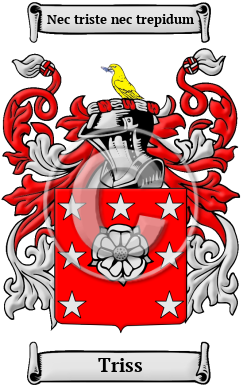
| ![Show Contents]() Triss History, Family Crest & Coats of Arms Triss History, Family Crest & Coats of Arms
- Origins Available:
England
Etymology of TrissWhat does the name Triss mean? Cornwall, one of the original six "Celtic nations" is the homeland to the surname Triss. A revival of the Cornish language which began in the 9th century AD has begun. No doubt this was the language spoken by distant forebears of the Triss family. Though surnames became common during medieval times, English people were formerly known only by a single name. The way in which hereditary surnames were adopted in medieval England is fascinating. Many Cornish surnames appear to be topographic surnames, which were given to people who resided near physical features such as hills, streams, churches, or types of trees, many are actually habitation surnames. The name Triss is a local type of surname and the Triss family lived in Cornwall. Their name, however, is derived from the Old French word triste, meaning meeting place, and indicates that they lived near a popular meeting place. Early Origins of the Triss familyThe surname Triss was first found in Cornwall where they held a family seat at Lords of the Manor of Parc Behan. The main stem of this distinguished Cornish family flourished until the 15th or 16th centuries. It is curious how the evolution of the family motto has been woven around the family surname 'Nec Triste, Nec trepidum', Neither sad nor fearful. This used to be a common practice in the 13th and 14th centuries, particularly in war cries, which frequently held only one word, the family name. Early History of the Triss familyThis web page shows only a small excerpt of our Triss research. Another 78 words (6 lines of text) covering the year 1748 is included under the topic Early Triss History in all our PDF Extended History products and printed products wherever possible. Triss Spelling VariationsCornish surnames are characterized by a multitude of spelling variations. The frequent changes in surnames are due to the fact that the Old and Middle English languages lacked definite spelling rules. The official court languages, which were Latin and French, were also influential on the spelling of a surname. Since the spelling of surnames was rarely consistent in medieval times, and scribes and church officials recorded names as they sounded rather than adhering to any specific spelling rules, it was common to find the same individual referred to with different spellings of their surname in the ancient chronicles. Moreover, a large number of foreign names were brought into England, which accelerated and accentuated the alterations to the spelling of various surnames. Lastly, spelling variations often resulted from the linguistic differences between the people of Cornwall and the rest of England. The Cornish spoke a unique Brythonic Celtic language which was first recorded in written documents during the 10th century. However, they became increasingly Anglicized, and Cornish became extinct as a spoken language in 1777, although it has been revived by Cornish patriots in the modern era. The name has been spelled Trist, Triste, Triss, Trisse and others. Early Notables of the Triss familyMore information is included under the topic Early Triss Notables in all our PDF Extended History products and printed products wherever possible.
| Triss migration to the United States | + |
Amongst the settlers in North America with this distinguished name Triss were
Triss Settlers in United States in the 18th Century- David Triss who landed in North America in 1730
The motto was originally a war cry or slogan. Mottoes first began to be shown with arms in the 14th and 15th centuries, but were not in general use until the 17th century. Thus the oldest coats of arms generally do not include a motto. Mottoes seldom form part of the grant of arms: Under most heraldic authorities, a motto is an optional component of the coat of arms, and can be added to or changed at will; many families have chosen not to display a motto.
Motto: Nec triste nec trepidum
Motto Translation: Neither sad nor fearful.
 |