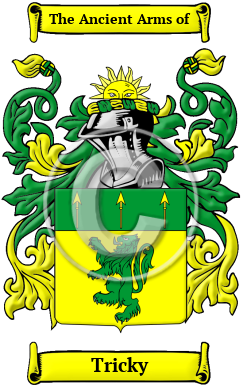
| ![Show Contents]() Tricky History, Family Crest & Coats of Arms Tricky History, Family Crest & Coats of Arms
- Origins Available:
England
Etymology of TrickyWhat does the name Tricky mean? The more common variants of this family, Trigg, Triggs and Trickey are all patronymic as in "the son of Trig." 1 The name tends to be from Northern England, but has spread throughout England. It is thought the name originated with the Norwegian Trygg, or the Old Norse Tryggui, meaning "true, trusty." 2 "Tryggui was, of course, the father of King Olaf Trygguason (Oláfr konungr Trygguason) of the sagas. The form in our 13th- 14th cent. records was Trig and Tryg. " 3 We do know that Tryggui was a Viking chieftain who sailed "west across the sea" to establish Norse settlements in England and Ireland. Early Origins of the Tricky familyThe surname Tricky was first found in Yorkshire where the mononym Trig was a Knights Templar in 1185. A few years later, William Trig was listed in the Assize Rolls for Lincolnshire in 1202. Later, Ralph Trigge was recorded in the Subsidy Rolls for Lancashire in 1332. 4 By the time of the Hundredorum Rolls of 1273, the family had spread throughout ancient England: Robert Trig, Cambridgeshire; William Triggs, Cambridgeshire; and Alan Trig, Lincolnshire. 1 In Somerset, a search through early rolls revealed William Tryg, Somerset, 1 Edward III (during the first year of Edward III's reign.) 5 In Yorkshire, Johannes Tryg was recorded in the Yorkshire Poll Tax Rolls of 1379. 1 In Devon, the first record of the Trickey variant was found in 1238. 4 Early History of the Tricky familyThis web page shows only a small excerpt of our Tricky research. Another 93 words (7 lines of text) covering the years 1273, 1547, 1549, 1589, 1597, 1606, 1657, 1685 and 1801 are included under the topic Early Tricky History in all our PDF Extended History products and printed products wherever possible. Tricky Spelling VariationsIt is only in the last few hundred years that the English language has been standardized. For that reason, early Anglo-Saxon surnames like Tricky are characterized by many spelling variations. As the English language changed and incorporated elements of other European languages, even literate people changed the spelling of their names. The variations of the name Tricky include: Trigg, Trig, Trygg, Trygge, Tryg, Trick, Trigge, Trick and many more. Early Notables of the Tricky familyAnother 45 words (3 lines of text) are included under the topic Early Tricky Notables in all our PDF Extended History products and printed products wherever possible. Migration of the Tricky familyMany English families tired of political and religious strife left Britain for the new colonies in North America. Although the trip itself offered no relief - conditions on the ships were extremely cramped, and many travelers arrived diseased, starving, and destitute - these immigrants believed the opportunities that awaited them were worth the risks. Once in the colonies, many of the families did indeed prosper and, in turn, made significant contributions to the culture and economies of the growing colonies. An inquiry into the early roots of North American families has revealed a number of immigrants bearing the name Tricky or a variant listed above: Samuell and Ellianor Trigg, who arrived in Virginia in 1639; Paul Trigg, who came to Virginia in 1654; Thomas Trigg, who was on record in Barbados in 1634.
- Bardsley, C.W, A Dictionary of English and Welsh Surnames: With Special American Instances. Wiltshire: Heraldry Today, 1901. Print. (ISBN 0-900455-44-6)
- Lower, Mark Anthony, Patronymica Britannica, A Dictionary of Family Names of the United Kingdom. London: John Russel Smith, 1860. Print.
- Harrison, Henry, Surnames of the United Kingdom: A Concise Etymological Dictionary Baltimore: Geneological Publishing Company, 2013. Print
- Reaney, P.H and R.M. Wilson, A Dictionary of English Surnames. London: Routledge, 1991. Print. (ISBN 0-415-05737-X)
- Dickinson, F.H., Kirby's Quest for Somerset of 16th of Edward the 3rd London: Harrison and Sons, Printers in Ordinary to Her Majesty, St, Martin's Lane, 1889. Print.
 |