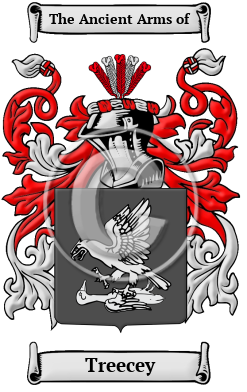
| ![Show Contents]() Treecey History, Family Crest & Coats of Arms Treecey History, Family Crest & Coats of Arms
- Origins Available:
Ireland
Etymology of TreeceyWhat does the name Treecey mean? The oldest instances of the Treecey surname in Ireland come from an Anglicized form of the Gaelic Ó Treasaigh, or "descendant of Treasach," a personal name meaning "warlike," "fierce." However, many of the surname Treecey come from Anglo-Norman roots, from the large category of Anglo-Norman habitation names, which are derived from pre-existing names for towns, villages, parishes, or farmsteads. Early Origins of the Treecey familyThe surname Treecey was first found in Devon, where they were Lords of Barnstaple, descended from a famous Norman family from Tracy near Vire in Carne in Normandy. William Tracey was a natural son of Henry I, and his descendant, Henry Tracey received from King Stephen the Barony of Barnstaple. His descendant, William Tracy, in 1170, was one of the murderers of Thomas A Becket, Archbishop of Canterbury. Early History of the Treecey familyThis web page shows only a small excerpt of our Treecey research. Another 97 words (7 lines of text) covering the years 1172, 1643 and 1648 are included under the topic Early Treecey History in all our PDF Extended History products and printed products wherever possible. Treecey Spelling VariationsDuring an investigation of the origin of each name, it was found that church officials and medieval scribes spelled many surnames as they sounded. Therefore, during the lifetime of a single person, a name could be spelt numerous ways. Some of the spelling variations for the name Treecey include Tracey, Tracy, Treacy, Trassey, Trasey, O'Tracy, O'Trasey, Tracye and many more. Early Notables of the Treecey familyAnother 28 words (2 lines of text) are included under the topic Early Treecey Notables in all our PDF Extended History products and printed products wherever possible. Migration of the Treecey familyA great number of Irish families left their homeland in the late 18th century and throughout the 19th century, migrating to such far away lands as Australia and North America. The early settlers left after much planning and deliberation. They were generally well off but they desired a tract of land that they could farm solely for themselves. The great mass of immigrants to arrive on North American shores in the 1840s differed greatly from their predecessors because many of them were utterly destitute, selling all they had to gain a passage on a ship or having their way paid by a philanthropic society. These Irish people were trying to escape the aftermath of the Great Potato Famine: poverty, starvation, disease, and, for many, ultimately death. Those that arrived on North American shores were not warmly welcomed by the established population, but they were vital to the rapid development of the industry, agriculture, and infrastructure of the infant nations of the United States and what would become Canada. Early passenger and immigration lists reveal many Irish settlers bearing the name Treecey: Catherine Tracey, a bonded passenger, who arrived in Maryland in 1733; David Tracey, who came to Nova Scotia in 1750; Dorothy Tracey, who came to Maryland in 1749.
 |