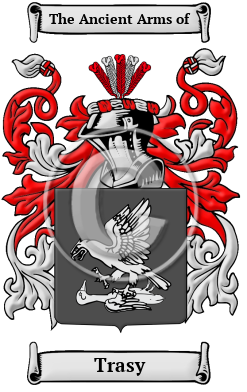
| ![Show Contents]() Trasy History, Family Crest & Coats of Arms Trasy History, Family Crest & Coats of Arms
- Origins Available:
Ireland
Etymology of TrasyWhat does the name Trasy mean? The oldest instances of the Trasy surname in Ireland come from an Anglicized form of the Gaelic Ó Treasaigh, or "descendant of Treasach," a personal name meaning "warlike," "fierce." However, many of the surname Trasy come from Anglo-Norman roots, from the large category of Anglo-Norman habitation names, which are derived from pre-existing names for towns, villages, parishes, or farmsteads. Early Origins of the Trasy familyThe surname Trasy was first found in Devon, where they were Lords of Barnstaple, descended from a famous Norman family from Tracy near Vire in Carne in Normandy. William Tracey was a natural son of Henry I, and his descendant, Henry Tracey received from King Stephen the Barony of Barnstaple. His descendant, William Tracy, in 1170, was one of the murderers of Thomas A Becket, Archbishop of Canterbury. Early History of the Trasy familyThis web page shows only a small excerpt of our Trasy research. Another 97 words (7 lines of text) covering the years 1172, 1643 and 1648 are included under the topic Early Trasy History in all our PDF Extended History products and printed products wherever possible. Trasy Spelling VariationsIt was found during an investigation of the origins of the name Trasy that church officials and medieval scribes often spelled the name as it sounded. This practice lead to a single person's being documented under many spelling variations. The name Trasy has existed in the various shapes: Tracey, Tracy, Treacy, Trassey, Trasey, O'Tracy, O'Trasey, Tracye and many more. Early Notables of the Trasy familyAnother 28 words (2 lines of text) are included under the topic Early Trasy Notables in all our PDF Extended History products and printed products wherever possible. Migration of the Trasy familyIrish immigration to North American began in the late 18th century as many Irish families desired to own their own land. This pattern of immigration grew slowly yet steadily until the 1840s. At that time, a failed crop and a growing population in Ireland resulted in the Great Potato Famine. Poverty, disease, and starvation ravaged the land. To ease their pain and suffering the Irish often looked upon North America as a solution: hundreds of thousands undertook the voyage. Their arrival meant the growth of industry and commerce for British North America and the United States. For the individual Irishman, it meant survival and hope, and the opportunity for work, freedom, and ownership of land. The early immigration and passenger lists revealed many bearing the name Trasy: Catherine Tracey, a bonded passenger, who arrived in Maryland in 1733; David Tracey, who came to Nova Scotia in 1750; Dorothy Tracey, who came to Maryland in 1749.
 |