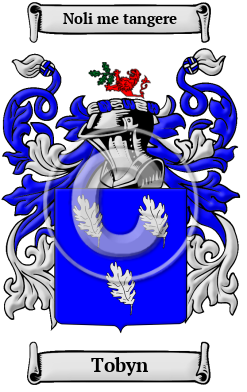
| ![Show Contents]() Tobyn History, Family Crest & Coats of Arms Tobyn History, Family Crest & Coats of Arms
Etymology of TobynWhat does the name Tobyn mean? When the Anglo-Normans began to settle in Ireland, they brought the tradition of local surnames to an island which already had a Gaelic naming system of hereditary surnames established. Unlike the Irish, the Anglo-Normans had an affinity for local surnames. Local surnames, such as Tobyn, were formed from the names of a place or a geographical landmark where the person lived, held land, or was born. The earliest Anglo-Norman surnames of this type came from Normandy, but as the Normans moved, they created names that referred to where they actually resided. Therefore, English places were used for names when the Normans lived in England, and then Irish places after these particular Anglo-Normans had been settled in Ireland for some time. Originally, these place names were prefixed by de, which means from in French. However, this type of prefix was eventually either made a part of the surname, if the place name began with a vowel, or it was eliminated entirely. The Tobyn family originally lived in the settlement of Aubyn in France. Thus, the surname Tobyn belongs to the class of topographic surnames, which were given to people who resided near physical features such as hills, streams, churches, or types of trees. The Tobyn family was originally called St. Aubyn, which was eventually corrupted to Tobyn. The Gaelic form of the surname is Tóibín. Early Origins of the Tobyn familyThe surname Tobyn was first found in Devon, where they held a family seat at the manor of Ashton known as "Place Barton," the heiress of this line married Sir John St. Aubyns. Sir John was the heir of the St. Aubyns of St. Aubyn du Thenney in Normandy, and was possessed of considerable estates at Pickwell, Georgeham, Berynarber, and Paracombe in north Devon. The name St. Aubyn gradually eroded to Torbyn and then Tobyn. Early History of the Tobyn familyThis web page shows only a small excerpt of our Tobyn research. Another 86 words (6 lines of text) covering the year 1819 is included under the topic Early Tobyn History in all our PDF Extended History products and printed products wherever possible. Tobyn Spelling VariationsSince church officials and medieval scribes spelt each name as it sounded to them; as a result, a single person could accumulate many different versions of his name within official records. A close examination of the origins of the name Tobyn revealed the following spelling variations: Tobin, Torbyn, Tobyn and others. Early Notables of the Tobyn familyMore information is included under the topic Early Tobyn Notables in all our PDF Extended History products and printed products wherever possible.
| Tobyn migration to New Zealand | + |
Emigration to New Zealand followed in the footsteps of the European explorers, such as Captain Cook (1769-70): first came sealers, whalers, missionaries, and traders. By 1838, the British New Zealand Company had begun buying land from the Maori tribes, and selling it to settlers, and, after the Treaty of Waitangi in 1840, many British families set out on the arduous six month journey from Britain to Aotearoa to start a new life. Early immigrants include: Tobyn Settlers in New Zealand in the 19th Century- Richard Tobyn, aged 21, who arrived in Wellington, New Zealand aboard the ship "Zealandia" in 1879
- Mary Tobyn, aged 17, who arrived in Wellington, New Zealand aboard the ship "Zealandia" in 1879
The motto was originally a war cry or slogan. Mottoes first began to be shown with arms in the 14th and 15th centuries, but were not in general use until the 17th century. Thus the oldest coats of arms generally do not include a motto. Mottoes seldom form part of the grant of arms: Under most heraldic authorities, a motto is an optional component of the coat of arms, and can be added to or changed at will; many families have chosen not to display a motto.
Motto: Noli me tangere
Motto Translation: Touch me not.
 |