| ![Show Contents]() Timbrel History, Family Crest & Coats of Arms Timbrel History, Family Crest & Coats of Arms
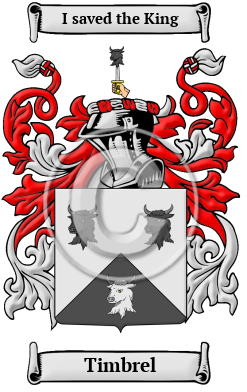
Etymology of TimbrelWhat does the name Timbrel mean? An ancient Scottish tribe called the Boernicians were the ancestors of the first people to use the surname Timbrel. It is a name for a man named Rule (sometimes Ruel) who saved King Robert the Bruce at Stirling Park from a charging bull by turning the bull's head. According to tradition, the King rewarded Rule with lands in Bedrule, and instructed him to change his name to Turnbull. This same man, Rule, is said to have served at the Battle of Halidon Hill in 1333, against the English. Rule preceded the Scottish Army into battle with a huge black dog, and challenged any Englishman to fight him. Sir Robert Venal of Norfolk accepted his challenge and killed both Rule and his dog. 1 While the account of the fight is most certainly true and well documented, the legend behind the name Turnbull is questionable. Timbrel Coat of Arms CreationThis is a Border clan name, and the progenitor is said to be a man of the name of Rule, who is reported to have twisted the head of a wild bull that attacked King Robert Bruce while hunting in Stirling Park, for which deed the King gave him the lands of Bedrule in Roxburghshire and the name Turnbull. He was a man of remarkable strength, and before the battle of Halidon Hill an old historian says :-" A certain stout champion of great stature, who for a fact by him done was called Turnbull, advanced before the Scots army; and a great mastiff dog with him; and challenged any of the English army to fight with him in combat; one Sir Robert Venal, a Norfolk man, by the King of England's leave, took him up, fought and killed him, and his dog too." This Norfolk knight evidently had more fighting skill than Turnbull.... He first slew the dog, and then managing to dodge Turnbull's thrust, he cut off his left arm and then his head. The crest of the Turribulls is a bull's head, and the motto, " Audaci favet Fortuna" (Fortune favours the brave). Another branch of the Turnbulls has the motto " Courage." 2 Early Origins of the Timbrel familyThe surname Timbrel was first found in Roxburghshire. Referring to the aforementioned Rule reference, there was a noble family of Rule, which derived its name from the Water of Rule, an affluent of the Teviot. This family dates back to 1214 when King William the Lion of Scotland granted lands to Alan de Rule. If the bull episode is true, then the bearer was either Adam de Rule or Thomas de Rule, the two Rule chieftains who appeared on the Ragman Rolls in 1296, just after the Stirling Park affair. Later, King Robert the Bruce did in fact grant lands in the west of Fulhophalche to William Turnbull in 1315. King David II also granted the lands of Humdallwalschop (now Hundleshop) to John Turnbull. 1 The source "The History of Liddesdale and the Debatable Land" includes the following entries for the family: David Trumbull or Turnbull, 1494; George Trumbull or Turnbull, 1404-5; Jock Trumble, 1544; and Wat Trombull, 1562. 3 Early History of the Timbrel familyThis web page shows only a small excerpt of our Timbrel research. Another 389 words (28 lines of text) covering the years 1214, 1296, 1315, 1329, 1333, 1400, 1447, 1450, 1454, 1545, 1562, 1591, 1633 and 1890 are included under the topic Early Timbrel History in all our PDF Extended History products and printed products wherever possible. Timbrel Spelling VariationsSpelling rules only evolved in the last few centuries with the invention of the printing press and the first dictionaries. Spelling variations are extremely common in names from before that period. Timbrel has been spelled Turnbull, Turnball, Trimble, Trimbell, Trumbell, Trumbill, Turnbul and many more. Early Notables of the Timbrel familyWilliam Turnbull (d. 1454), Bishop of Glasgow, who procured from the pope a charter to establish a university in the city in 1450. Later, George Turnbull (1562?-1633), was a Scottish Jesuit, was born about...
Another 32 words (2 lines of text) are included under the topic Early Timbrel Notables in all our PDF Extended History products and printed products wherever possible. Migration of the Timbrel family to IrelandSome of the Timbrel family moved to Ireland, but this topic is not covered in this excerpt.
Another 50 words (4 lines of text) about their life in Ireland is included in all our PDF Extended History products and printed products wherever possible. Migration of the Timbrel familyAfter making their great crossing, many Boernician-Scottish families settled along the east coast of North America. When the War of Independence broke out, United Empire Loyalists moved north to Canada while the rest stayed to fight. The ancestors of many of these Scots still populate the continent. This century, through Clan societies and other Scottish organizations, they began to rediscover their collective national heritage. Analysis of immigration records indicates that some of the first North American immigrants bore the name Timbrel or a variant listed above: Alexander Turnbull, who settled in East New Jersey in 1684; Thomas Turnbul, a Scottish prisoner sent to New Jersey in America in 1685; James Turnbull, who arrived in Charles Town [Charleston], South Carolina in 1734.
The motto was originally a war cry or slogan. Mottoes first began to be shown with arms in the 14th and 15th centuries, but were not in general use until the 17th century. Thus the oldest coats of arms generally do not include a motto. Mottoes seldom form part of the grant of arms: Under most heraldic authorities, a motto is an optional component of the coat of arms, and can be added to or changed at will; many families have chosen not to display a motto.
Motto: I saved the King
- Black, George F., The Surnames of Scotland Their Origin, Meaning and History. New York: New York Public Library, 1946. Print. (ISBN 0-87104-172-3)
- Polson, Alexander, The Romance of Scottish Crests and Mottoes. Inverness: Walter Alexander, Inglis Street 1929. Print
- Bardsley, C.W, A Dictionary of English and Welsh Surnames: With Special American Instances. Wiltshire: Heraldry Today, 1901. Print. (ISBN 0-900455-44-6)
 |