| ![Show Contents]() Thorburns History, Family Crest & Coats of Arms Thorburns History, Family Crest & Coats of Arms
Etymology of ThorburnsWhat does the name Thorburns mean? The origins of the name Thorburns are with the Anglo-Saxon tribes of Britain. The name is derived from the baptismal name for the son of Thurburn. This ancient personal name was originally derived from the name of the Saxon God of Thunder, Thor. After the Norman Conquest, the Old English naming system gradually dissolved. Old English names became less common and were replaced by popular continental European names. The earliest surnames in England were found shortly after the Norman Conquest and are of Norman French rather than native English origins. Early Origins of the Thorburns familyThe surname Thorburns was first found in Norfolk where Thomas filius Thurbernus (Turberni) was listed 1153-1186. A few years later, Richard Turbern was listed in the Feet of Fines in 1198 and later, Richard Thurubern was listed at Ely in Norfolk in 1277. The name may have been listed in the Domesday Book as Thurbernus, Turbern and Torbern, 1 but it from the Norfolk branch that seems the most prevalent in these early years. Spellings widely varied as we found: Thurbarnus filius Ailiue in the Feet of Fines for Suffolk in 1197; Richard Turbern in the Feet of Fines for Norfolk in 1198; William Thurbern in the Assize Rolls for Warwickshire in 1221; and Richard Thurubern at Ely, Norfolk in 1277. 1 In Sussex, the name claims descendancy from Thunder (Thor) or Thunder's Hill at Chittingly. Thor was the name of the ancient Saxon God of Thunder. As to underscore the wide use on the name by the 13th century, the Hundredorum Rolls of 1273 included: William Thorebern, Oxfordshire; Richard Thorbarn, Oxfordshire; Dominus Thurbern, Suffolk; and Nicholas Thurbern, Wiltshire. 2 In Somerset, Philip Thorbarn was listed there 1 Edward III (during the first year of the reign of King Edward III.) 3 Early History of the Thorburns familyThis web page shows only a small excerpt of our Thorburns research. Another 49 words (4 lines of text) covering the years 1197, 1273, 1327, 1607, 1656, 1659 and 1688 are included under the topic Early Thorburns History in all our PDF Extended History products and printed products wherever possible. Thorburns Spelling VariationsThe first dictionaries that appeared in the last few hundred years did much to standardize the English language. Before that time, spelling variations in names were a common occurrence. The language was changing, incorporating pieces of other languages, and the spelling of names changed with it. Thorburns has been spelled many different ways, including Thorburn, Thurburn, Thurbrand, Torburn and others. Early Notables of the Thorburns familyMore information is included under the topic Early Thorburns Notables in all our PDF Extended History products and printed products wherever possible. Migration of the Thorburns familyThousands of English families in this era began to emigrate the New World in search of land and freedom from religious and political persecution. Although the passage was expensive and the ships were dark, crowded, and unsafe, those who made the voyage safely were rewarded with opportunities unavailable to them in their homeland. Research into passenger and immigration lists has revealed some of the very first Thorburnss to arrive in North America: William Thorburn arrived in Virginia in 1716; Andrew Torburn arrived in New York City with his mother Margaret in 1774; Sir Robert Thorburn, K.C.M.G. from Juniper Bank, Peeblesshire, came to St. John'.
The motto was originally a war cry or slogan. Mottoes first began to be shown with arms in the 14th and 15th centuries, but were not in general use until the 17th century. Thus the oldest coats of arms generally do not include a motto. Mottoes seldom form part of the grant of arms: Under most heraldic authorities, a motto is an optional component of the coat of arms, and can be added to or changed at will; many families have chosen not to display a motto.
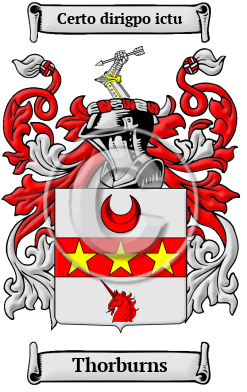
Motto: Certo dirigpo ictu
- Reaney, P.H and R.M. Wilson, A Dictionary of English Surnames. London: Routledge, 1991. Print. (ISBN 0-415-05737-X)
- Bardsley, C.W, A Dictionary of English and Welsh Surnames: With Special American Instances. Wiltshire: Heraldry Today, 1901. Print. (ISBN 0-900455-44-6)
- Dickinson, F.H., Kirby's Quest for Somerset of 16th of Edward the 3rd London: Harrison and Sons, Printers in Ordinary to Her Majesty, St, Martin's Lane, 1889. Print.
 |