| ![Show Contents]() Tause History, Family Crest & Coats of Arms Tause History, Family Crest & Coats of Arms
- Origins Available:
Scotland
Early Origins of the Tause familyThe surname Tause was first found in Perthshire (Gaelic: Siorrachd Pheairt) former county in the present day Council Area of Perth and Kinross, located in central Scotland, where they held a family seat from very ancient times, before and after the Norman Conquest in 1066. The Tassie variant has a most interesting origin. "The Tassies had long resided in Pollokshaws, and were believed to have come from Italy as refugees, and to have settled in Scotland as tanners and skinners. " 1 The name today is "a phonetic spelling of Gaelic Tamhas, 'Thomas.' The surname Taise, found in Mar in the seventeenth century, is probably another form of the name. " 2 And some of the earliest entries for the name include: Tawus M'Gillese, a tenant under the earl of Douglas in 1376, Tawis Michison who appears as a charter witness in 1415 and Taus ffrasser of Littlegarth who is mentioned in 1632. While these entries are the name as a forename, it was not until 1667 that the name was entered as a surname: William Taus, tailor in Dunkeld who died in 1667. 2 Early History of the Tause familyThis web page shows only a small excerpt of our Tause research. Another 107 words (8 lines of text) covering the years 1376, 1415, 1632 and 1733 are included under the topic Early Tause History in all our PDF Extended History products and printed products wherever possible. Tause Spelling VariationsSpelling variations of this family name include: Taws, Taw, Tawse and others. Early Notables of the Tause familyMore information is included under the topic Early Tause Notables in all our PDF Extended History products and printed products wherever possible.
| Tause migration to New Zealand | + |
Emigration to New Zealand followed in the footsteps of the European explorers, such as Captain Cook (1769-70): first came sealers, whalers, missionaries, and traders. By 1838, the British New Zealand Company had begun buying land from the Maori tribes, and selling it to settlers, and, after the Treaty of Waitangi in 1840, many British families set out on the arduous six month journey from Britain to Aotearoa to start a new life. Early immigrants include: Tause Settlers in New Zealand in the 19th Century- Mr. Hector Tause, Australian settler travelling from Melbourne, Victoria aboard the ship "Dunedin" arriving in Dunedin, South Island, New Zealand on 12th March 1860 3
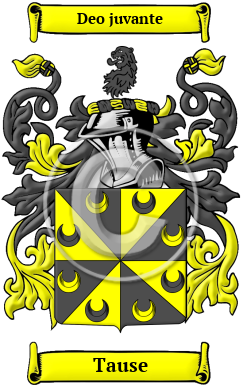
The motto was originally a war cry or slogan. Mottoes first began to be shown with arms in the 14th and 15th centuries, but were not in general use until the 17th century. Thus the oldest coats of arms generally do not include a motto. Mottoes seldom form part of the grant of arms: Under most heraldic authorities, a motto is an optional component of the coat of arms, and can be added to or changed at will; many families have chosen not to display a motto.
Motto: Deo juvante
Motto Translation: By God’s assistance.
- Smith, George (ed), Dictionary of National Biography. London: Smith, Elder & Co., 1885-1900. Print
- Black, George F., The Surnames of Scotland Their Origin, Meaning and History. New York: New York Public Library, 1946. Print. (ISBN 0-87104-172-3)
- New Zealand Yesteryears Passenger Lists 1800 to 1900 (Retrieved 17th October 2018). Retrieved from http://www.yesteryears.co.nz/shipping/passlist.html
 |