| ![Show Contents]() Tagney History, Family Crest & Coats of Arms Tagney History, Family Crest & Coats of Arms
- Origins Available:
Ireland
Etymology of TagneyWhat does the name Tagney mean? The surname Tagney comes from the Irish Gaelic "O Teangna" and refers to a "descendant of Teangana." This personal name is an Old Breton name composed of the element "tan" meaning "fire" and "ci" meaning "dog," and was born by a sixth century Christian saint. Early Origins of the Tagney familyThe surname Tagney was first found in County Kerry (Irish:Ciarraí) part of the former County Desmond (14th-17th centuries), located in Southwestern Ireland, in Munster province. Early History of the Tagney familyThis web page shows only a small excerpt of our Tagney research. Another 27 words (2 lines of text) are included under the topic Early Tagney History in all our PDF Extended History products and printed products wherever possible. Tagney Spelling VariationsSpelling variations of this family name include: Tangney, O'Tangney, Tagney, Tangley and others. Early Notables of the Tagney familyMore information is included under the topic Early Tagney Notables in all our PDF Extended History products and printed products wherever possible.
| Tagney migration to the United States | + |
Tagney Settlers in United States in the 19th Century- Eliza Tagney, who immigrated to Boston in 1847
- John Tagney, who arrived in New York in 1849
- Patrick Tagney, who arrived in New York in 1854
- Mary Tagney, who landed in New York in 1856
| Tagney migration to Australia | + |
Tagney Settlers in Australia in the 19th Century- Margaret Tagney, English convict from Dorset, who was transported aboard the "America" on December 30, 1830, settling in Van Diemen's Land, Australia 1
| Tagney migration to New Zealand | + |
Emigration to New Zealand followed in the footsteps of the European explorers, such as Captain Cook (1769-70): first came sealers, whalers, missionaries, and traders. By 1838, the British New Zealand Company had begun buying land from the Maori tribes, and selling it to settlers, and, after the Treaty of Waitangi in 1840, many British families set out on the arduous six month journey from Britain to Aotearoa to start a new life. Early immigrants include: Tagney Settlers in New Zealand in the 19th Century- Miss Catherine Tagney, aged 19, Irish servant who arrived in Port Chalmers, New Zealand aboard the ship "Oamaru" in 1878
| Contemporary Notables of the name Tagney (post 1700) | + |
- E.F. Tagney, American businessman, co-owner of the Hotel Kirkwood, Des Moines, Iowa in 1930, now listed on the National Register of Historic Places
- Maggie Tagney, British actress, known for Girls' Night (1998), Vacuuming Completely Nude in Paradise (2001) and Heartbeat (1992)
- Philip Tagney, English co-founder of the Langham Research Centre, a group devoted to authentic performances of classic electronic music in 2003
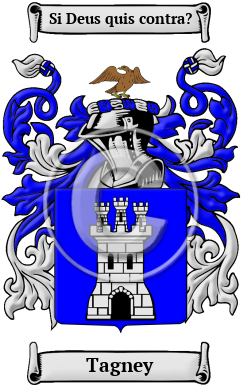
The motto was originally a war cry or slogan. Mottoes first began to be shown with arms in the 14th and 15th centuries, but were not in general use until the 17th century. Thus the oldest coats of arms generally do not include a motto. Mottoes seldom form part of the grant of arms: Under most heraldic authorities, a motto is an optional component of the coat of arms, and can be added to or changed at will; many families have chosen not to display a motto.
Motto: Si Deus quis contra?
Motto Translation: If God be with us who can be against us?.
- State Library of Queensland. (Retrieved 2014, November 26) America voyage to Van Diemen's Land, Australia in 1830 with 135 passengers. Retrieved from http://www.convictrecords.com.au/ships/america/1830
 |