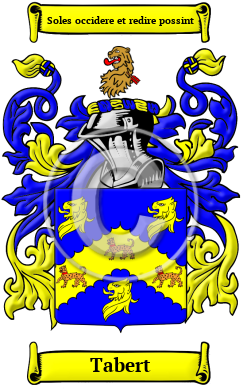
| ![Show Contents]() Tabert History, Family Crest & Coats of Arms Tabert History, Family Crest & Coats of Arms
Etymology of TabertWhat does the name Tabert mean? The Anglo-Saxons of Britain first developed the name Tabert. It was a name given to someone who was a person who was known as the taborer, the player on the small drum. Occupational names that were derived from the common trades of the medieval era transcended European cultural and linguistic boundaries. These surnames were frequently derived from the principal object associated with the activity of the original bearer, such as tools or products, in this case the tabor. These types of occupational surnames are called metonymic surnames. Early Origins of the Tabert familyThe surname Tabert was first found in Essex where they held a family seat from very ancient times, before and after the Norman Conquest in 1066. Early History of the Tabert familyThis web page shows only a small excerpt of our Tabert research. Another 91 words (6 lines of text) covering the years 1642, 1681, 1761 and 1788 are included under the topic Early Tabert History in all our PDF Extended History products and printed products wherever possible. Tabert Spelling VariationsSpelling variations in names were a common occurrence before English spelling was standardized a few hundred years ago. In the Middle Ages, even the literate spelled their names differently as the English language incorporated elements of French, Latin, and other European languages. Many variations of the name Tabert have been found, including Taber, Tabert, Tabor and others. Early Notables of the Tabert familyAnother 50 words (4 lines of text) are included under the topic Early Tabert Notables in all our PDF Extended History products and printed products wherever possible.
| Tabert migration to the United States | + |
Families began migrating abroad in enormous numbers because of the political and religious discontent in England. Often faced with persecution and starvation in England, the possibilities of the New World attracted many English people. Although the ocean trips took many lives, those who did get to North America were instrumental in building the necessary groundwork for what would become for new powerful nations. Among the first immigrants of the name Tabert, or a variant listed above to cross the Atlantic and come to North America were:
Tabert Settlers in United States in the 19th Century- Benjamin Tabert, aged 19, who arrived in New York, NY in 1875 1
- Jacob Tabert, aged 24, who landed in New York, NY in 1875 1
- Marie Tabert, aged 19, who arrived in New York, NY in 1875 1
| Tabert migration to West Indies | + |
The British first settled the British West Indies around 1604. They made many attempts but failed in some to establish settlements on the Islands including Saint Lucia and Grenada. By 1627 they had managed to establish settlements on St. Kitts (St. Christopher) and Barbados, but by 1641 the Spanish had moved in and destroyed some of these including those at Providence Island. The British continued to expand the settlements including setting the First Federation in the British West Indies by 1674; some of the islands include Barbados, Bermuda, Cayman Island, Turks and Caicos, Jamaica and Belize then known as British Honduras. By the 1960's many of the islands became independent after the West Indies Federation which existed from 1958 to 1962 failed due to internal political conflicts. After this a number of Eastern Caribbean islands formed a free association. 2Tabert Settlers in West Indies in the 17th Century- Richard Tabert, who settled in Jamaica in 1654
The motto was originally a war cry or slogan. Mottoes first began to be shown with arms in the 14th and 15th centuries, but were not in general use until the 17th century. Thus the oldest coats of arms generally do not include a motto. Mottoes seldom form part of the grant of arms: Under most heraldic authorities, a motto is an optional component of the coat of arms, and can be added to or changed at will; many families have chosen not to display a motto.
Motto: Soles occidere et redire possint
Motto Translation: The sun sets and they can
- Filby, P. William, Meyer, Mary K., Passenger and immigration lists index : a guide to published arrival records of about 500,000 passengers who came to the United States and Canada in the seventeenth, eighteenth, and nineteenth centuries. 1982-1985 Cumulated Supplements in Four Volumes Detroit, Mich. : Gale Research Co., 1985, Print (ISBN 0-8103-1795-8)
- https://en.wikipedia.org/wiki/British_West_Indies
 |