| ![Show Contents]() Starke History, Family Crest & Coats of Arms Starke History, Family Crest & Coats of Arms
Etymology of StarkeWhat does the name Starke mean? The name Starke is an ancient Anglo-Saxon name that was given to a person who was a person who is firm, or resolute. Starke is a nickname surname, which belongs to the category of hereditary surnames. Nicknames form a broad and miscellaneous class of surnames, and can refer directly or indirectly to one's personality, physical attributes, mannerisms, or even their habits of dress. The surname Starke comes from the Old English word stark, which means firm, and was given to someone who was powerful or resolute. This family was established in Suffolk since the early Middle Ages. Early Origins of the Starke familyThe surname Starke was first found in Suffolk, where the Starke family held a family seat from ancient times. Early History of the Starke familyThis web page shows only a small excerpt of our Starke research. Another 159 words (11 lines of text) covering the years 1222, 1273, 1314, 1376, 1540, 1544, 1677, 1728, 1745, 1757, 1794 and 1822 are included under the topic Early Starke History in all our PDF Extended History products and printed products wherever possible. Starke Spelling VariationsOnly recently has spelling become standardized in the English language. As the English language evolved in the Middle Ages, the spelling of names changed also. The name Starke has undergone many spelling variations, including Stark, Starck, Starke, Starckman, Sterke, Sterk, Starkey, Starkie and many more. Early Notables of the Starke familyMore information is included under the topic Early Starke Notables in all our PDF Extended History products and printed products wherever possible. Starke RankingIn the United States, the name Starke is the 10,974th most popular surname with an estimated 2,487 people with that name. 1
| Starke migration to the United States | + |
To escape the unstable social climate in England of this time, many families boarded ships for the New World with the hope of finding land, opportunity, and greater religious and political freedom. Although the voyages were expensive, crowded, and difficult, those families that arrived often found greater opportunities and freedoms than they could have experienced at home. Many of those families went on to make significant contributions to the rapidly developing colonies in which they settled. Early North American records indicate many people bearing the name Starke were among those contributors:
Starke Settlers in United States in the 17th Century- Comfort Starke, who landed in New England in 1634 2
Starke Settlers in United States in the 18th Century- Johann Ludwig Starke and Tobias Starke, who settled in America in 1753
- Tobias Starke, who landed in Pennsylvania in 1753 2
- Joh Ludwig Starke, who landed in Pennsylvania in 1753 2
Starke Settlers in United States in the 19th Century- Christine Starke, who landed in Texas in 1845 2
- Marie Starke, who landed in Texas in 1846 2
- Max and Otto Starke, who settled in Texas in 1852
- Auguste Starke, who settled in Texas in 1853
| Starke migration to Australia | + |
Starke Settlers in Australia in the 19th Century- Thomas R. Starke, aged 25, who arrived in South Australia in 1849 aboard the ship "Marion" 3
- Sarah Starke, who arrived in Adelaide, Australia aboard the ship "Marion" in 1849 3
- Thomas R. Starke, aged 25, who arrived in Adelaide, Australia aboard the ship "Marion" in 1849 3
- Elizabeth Starke, aged 28, who arrived in Adelaide, Australia aboard the ship "Marion" in 1849 3
- Thomas E. Starke, aged 1, who arrived in Adelaide, Australia aboard the ship "Marion" in 1849 3
- ... (More are available in all our PDF Extended History products and printed products wherever possible.)
| Starke migration to New Zealand | + |
Emigration to New Zealand followed in the footsteps of the European explorers, such as Captain Cook (1769-70): first came sealers, whalers, missionaries, and traders. By 1838, the British New Zealand Company had begun buying land from the Maori tribes, and selling it to settlers, and, after the Treaty of Waitangi in 1840, many British families set out on the arduous six month journey from Britain to Aotearoa to start a new life. Early immigrants include: Starke Settlers in New Zealand in the 19th Century- Henry Starke, who arrived in Lyttelton, New Zealand aboard the ship "Blue Jacket" in 1865
- Mary Starke, who arrived in Lyttelton, New Zealand aboard the ship "Blue Jacket" in 1865
- William Starke, who arrived in Lyttelton, New Zealand aboard the ship "Blue Jacket" in 1865
- Richard Starke, who arrived in Lyttelton, New Zealand aboard the ship "Blue Jacket" in 1865
- Prudence Starke, who arrived in Lyttelton, New Zealand aboard the ship "Blue Jacket" in 1865
- ... (More are available in all our PDF Extended History products and printed products wherever possible.)
| Contemporary Notables of the name Starke (post 1700) | + |
- Anthony Starke (b. 1963), American actor
- Michael Starke (b. 1955), American neo-baroque composer
- Pauline Starke (1901-1977), American silent-film actress from Joplin, Missouri, she has a star on the Hollywood Walk of Fame
- George Lawrence Starke (b. 1948), American former NFL football offensive lineman who played for the Washington Redskins
- Mariana Starke (1761-1838), English travel guide writer, daughter of Richard Starke by his wife Mary; her father was for some time governor of Fort St. George in Madras, and later a resident at Epsom, Surrey
- Sean Starke (b. 1980), Canadian retired former professional ice hockey player
- Kurt Starke (1911-2000), German radiochemist
- Ute Starke (1939-1968), German bronze medalist gymnast at the 1968 Summer Olympics
- Benjamin Starke (b. 1986), German silver and bronze medalist Olympic swimmer
- ... (Another 7 notables are available in all our PDF Extended History products and printed products wherever possible.)
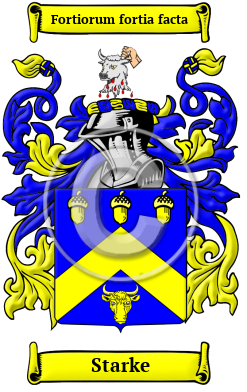
The motto was originally a war cry or slogan. Mottoes first began to be shown with arms in the 14th and 15th centuries, but were not in general use until the 17th century. Thus the oldest coats of arms generally do not include a motto. Mottoes seldom form part of the grant of arms: Under most heraldic authorities, a motto is an optional component of the coat of arms, and can be added to or changed at will; many families have chosen not to display a motto.
Motto: Fortiorum fortia facta
Motto Translation: The brave deeds of brave men.
| Suggested Readings for the name Starke | + |
- The Starkey Family of Saybrook (Essex) Connecticut by Margaret Buckridge Bock.
- "What are the 5,000 Most Common Last Names in the U.S.?". NameCensus.com, https://namecensus.com/last-names/
- Filby, P. William, Meyer, Mary K., Passenger and immigration lists index : a guide to published arrival records of about 500,000 passengers who came to the United States and Canada in the seventeenth, eighteenth, and nineteenth centuries. 1982-1985 Cumulated Supplements in Four Volumes Detroit, Mich. : Gale Research Co., 1985, Print (ISBN 0-8103-1795-8)
- State Records of South Australia. (Retrieved 2010, November 5) The MARION 1849. Retrieved from http://www.slsa.sa.gov.au/BSA/1849Marion.htm
 |