| ![Show Contents]() Spynk History, Family Crest & Coats of Arms Spynk History, Family Crest & Coats of Arms
- Origins Available:
England
Etymology of SpynkWhat does the name Spynk mean? The origins of the Anglo-Saxon name Spynk come from its first bearer, who was a person who because his physical characteristics was referred to as the spink, which literally means the finch. Often nicknames described strong traits or attributes that people wished to emulate in a specific animal. In the pre-Christian era, many pagan gods and demigods were believed to be a mixture of animals and humans, such as the Greek god Pan who was the god of flocks and herds and was represented as a man with the legs, horns and ears of a goat. In the Middle Ages, anthropomorphic ideas, which attributed human qualities and form to gods or animals, were held about the characters of other living creatures. They were based on the creature's habits. Moreover, these associations were reflected in folk tales, mythology, and legends which portrayed animals behaving as humans. Early Origins of the Spynk familyThe surname Spynk was first found in Northampton where they held a family seat from very ancient times, some say well before the Norman Conquest and the arrival of Duke William at Hastings in 1066 A.D. Early History of the Spynk familyThis web page shows only a small excerpt of our Spynk research. Another 125 words (9 lines of text) covering the years 1261, 1418, 1419, 1653, 1713 and 1727 are included under the topic Early Spynk History in all our PDF Extended History products and printed products wherever possible. Spynk Spelling VariationsThe first dictionaries that appeared in the last few hundred years did much to standardize the English language. Before that time, spelling variations in names were a common occurrence. The language was changing, incorporating pieces of other languages, and the spelling of names changed with it. Spynk has been spelled many different ways, including Spink, Spinks, Spinkes, Spink and others. Early Notables of the Spynk familyNathaniel Spinckes (1653-1727), English nonjuror, born in 1653 at Castor in Northamptonshire, where his father, Edmund Spinckes, was rector of the parish. "Spinckes' high character and varied learning gave him a leading position among the nonjuring divines; he was entrusted with the management...
Another 42 words (3 lines of text) are included under the topic Early Spynk Notables in all our PDF Extended History products and printed products wherever possible.
| Spynk migration to the United States | + |
Thousands of English families in this era began to emigrate the New World in search of land and freedom from religious and political persecution. Although the passage was expensive and the ships were dark, crowded, and unsafe, those who made the voyage safely were rewarded with opportunities unavailable to them in their homeland. Research into passenger and immigration lists has revealed some of the very first Spynks to arrive in North America:
Spynk Settlers in United States in the 17th Century- Robert Spynk, aged 20, who arrived in Virginia in 1635 aboard the ship "Speedwell" 1
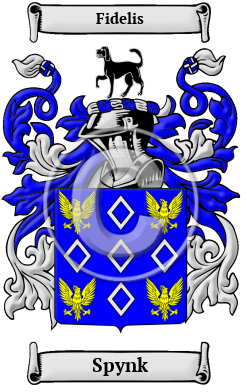
The motto was originally a war cry or slogan. Mottoes first began to be shown with arms in the 14th and 15th centuries, but were not in general use until the 17th century. Thus the oldest coats of arms generally do not include a motto. Mottoes seldom form part of the grant of arms: Under most heraldic authorities, a motto is an optional component of the coat of arms, and can be added to or changed at will; many families have chosen not to display a motto.
Motto: Fidelis
Motto Translation: Faithful.
- Filby, P. William, Meyer, Mary K., Passenger and immigration lists index : a guide to published arrival records of about 500,000 passengers who came to the United States and Canada in the seventeenth, eighteenth, and nineteenth centuries. 1982-1985 Cumulated Supplements in Four Volumes Detroit, Mich. : Gale Research Co., 1985, Print (ISBN 0-8103-1795-8)
 |