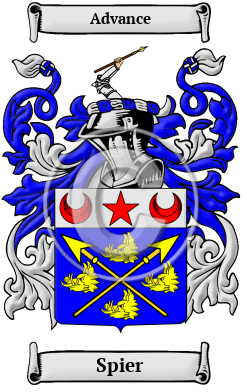
| ![Show Contents]() Spier History, Family Crest & Coats of Arms Spier History, Family Crest & Coats of Arms
Etymology of SpierWhat does the name Spier mean? The Spier surname comes from the Old English word "spere," meaning "spear." It may have originally been a nickname for a tall skinny person, or perhaps for a hunter skilled at using the spear. Alternatively, the could have been used for a "watchman or lookout man." 1 2 3 Another source notes: "Spere, to ask, to inquire; a word used formerly in Scotland and the north of Ireland." 4 Early Origins of the Spier familyThe surname Spier was first found in Renfrewshire (Gaelic: Siorrachd Rinn Friù), a historic county of Scotland, today encompassing the Council Areas of Renfrew, East Renfrewshire, and Iverclyde, in the Strathclyde region of southwestern Scotland. Further to the south in Yorkshire, England, the first record of the family was found in the Yorkshire Poll Tax Rolls of 1379 when Robertas Spyer was listed there at that time. 2 By the 16th century, Richard Spyre was listed as attending Oxford University in 1515; and George Speris was listed in Stirling, Scotland in 1548. 3 Early History of the Spier familyThis web page shows only a small excerpt of our Spier research. Another 77 words (6 lines of text) covering the years 1417, 1475, 1626, 1664, 1807, 1846, 1869, 1884 and 1890 are included under the topic Early Spier History in all our PDF Extended History products and printed products wherever possible. Spier Spelling VariationsSpelling variations of this family name include: Speir, Spier, Spears, Speirs, Spiers, Speer, Speers, Spere, Speres, Spire, Spires, Speyer, Speier, Speery and many more. Early Notables of the Spier family- Alexander Spiers (1807-1869), the English lexicographer, was born at Gosport in Hampshire in 1807...
Spier RankingIn the United States, the name Spier is the 15,993rd most popular surname with an estimated 2,487 people with that name. 5 Migration of the Spier family to IrelandSome of the Spier family moved to Ireland, but this topic is not covered in this excerpt.
Another 57 words (4 lines of text) about their life in Ireland is included in all our PDF Extended History products and printed products wherever possible.
| Spier migration to the United States | + |
Spier Settlers in United States in the 17th Century- Johannes Spier, who landed in America in 1650 7
- Mrs. Hendrick Jansen Spier, who arrived in New York in 1660 7
- Hendrick Jansen Spier, who landed in New York, NY in 1660 7
Spier Settlers in United States in the 18th Century- David Spier, who arrived in New England in 1727 7
- John Spier, who arrived in North Carolina in 1740 7
- William Spier, who arrived in North Carolina in 1740 7
- George Frederick Spier, aged 40, who arrived in Pennsylvania in 1775 7
- Bernard Spier, who landed in Philadelphia, Pennsylvania in 1792 7
Spier Settlers in United States in the 19th Century- Christiana Spier, who landed in Pennsylvania in 1803 7
- John, Mary, Samuel, William, and Michael Spier all, who settled in Baltimore in 1820
- Isaac Spier, aged 17, who arrived in New York in 1854 7
| Spier migration to Australia | + |
Emigration to Australia included the Second Fleet of convicts, tradespeople and early settlers. Early immigrants include: Second Fleet - Mr. William Spier, (d. 1791), British settler convicted in Warwickshire, England in 1790, sentenced to 7 years for stealing, transported aboard the ship "Britannia" leaving in 1790 arriving in New South Wales, Australia in 1791, may have died on the ship 6
| Contemporary Notables of the name Spier (post 1700) | + |
- Silas B. Spier, American Republican politician, Alternate Delegate to Republican National Convention from Michigan, 1892 ; Candidate in primary for Circuit Judge in Michigan 16th Circuit, 1911 8
- Joseph Spier, American politician, Member of New York State Assembly from Montgomery and Hamilton counties, 1823, 1829 9
- James E. Spier, American Republican politician, Circuit Judge in Michigan 16th Circuit, 1929-67; Appointed 1929 9
The motto was originally a war cry or slogan. Mottoes first began to be shown with arms in the 14th and 15th centuries, but were not in general use until the 17th century. Thus the oldest coats of arms generally do not include a motto. Mottoes seldom form part of the grant of arms: Under most heraldic authorities, a motto is an optional component of the coat of arms, and can be added to or changed at will; many families have chosen not to display a motto.
Motto: Advance
- Smith, Eldson Coles, New Dictionary of American Family Names New York: Harper & Row, 1956. Print
- Bardsley, C.W, A Dictionary of English and Welsh Surnames: With Special American Instances. Wiltshire: Heraldry Today, 1901. Print. (ISBN 0-900455-44-6)
- Black, George F., The Surnames of Scotland Their Origin, Meaning and History. New York: New York Public Library, 1946. Print. (ISBN 0-87104-172-3)
- Arthur, William , An Etymological Dictionary of Family and Christian Names. London: 1857. Print
- "What are the 5,000 Most Common Last Names in the U.S.?". NameCensus.com, https://namecensus.com/last-names/
- Convict Records of Australia. Retrieved 4th February 2021 from https://convictrecords.com.au/ships
- Filby, P. William, Meyer, Mary K., Passenger and immigration lists index : a guide to published arrival records of about 500,000 passengers who came to the United States and Canada in the seventeenth, eighteenth, and nineteenth centuries. 1982-1985 Cumulated Supplements in Four Volumes Detroit, Mich. : Gale Research Co., 1985, Print (ISBN 0-8103-1795-8)
- The Political Graveyard: Alphabetical Name Index. (Retrieved 2015, November 11) . Retrieved from http://politicalgraveyard.com/alpha/index.html
 |