| ![Show Contents]() Smellie History, Family Crest & Coats of Arms Smellie History, Family Crest & Coats of Arms
Etymology of SmellieWhat does the name Smellie mean? The Hebrides islands and Western coastal mountains of Scotland were once part of the ancient kingdom of Dalriada. The name Smellie was born there, as a nickname for a for a person noted for their smile, or happy personality. Smellie is thus, a nickname surname, which belongs to the category of hereditary surnames. Nicknames form a broad and miscellaneous class of surnames, and can refer directly or indirectly to one's personality, physical attributes, mannerisms, or even their habits of dress. The surname Smellie comes from the Old English word, smile, which means grin. Therefore, the surname Smellie would have been adopted by someone with a distinct smile, or grin. Early Origins of the Smellie familyThe surname Smellie was first found in Cumberland, a historic county of North West England, now known as Cumbria. Early History of the Smellie familyThis web page shows only a small excerpt of our Smellie research. Another 74 words (5 lines of text) covering the years 1600, 1630, 1660, 1670, 1689, 1697, 1740, 1763, 1774, 1787, 1795, 1890 and 1968 are included under the topic Early Smellie History in all our PDF Extended History products and printed products wherever possible. Smellie Spelling VariationsTranslation in medieval times was an undeveloped science and was often carried out without due care. For this reason, many early Scottish names appeared radically altered when written in English. The spelling variations of Smellie include Smiley, Smellie, Smyly, Smyley, Smilley, Smilie and many more. Early Notables of the Smellie family- William Smellie (1697-1763), Scottish obstetrician, who has been called the father of British midwifery
- William Smellie (1740-1795), a Scottish encyclopedist, master printer, Fellow of the Royal Society, the Society of Antiquaries of Scotland and naturalist
Migration of the Smellie family to IrelandSome of the Smellie family moved to Ireland, but this topic is not covered in this excerpt.
Another 163 words (12 lines of text) about their life in Ireland is included in all our PDF Extended History products and printed products wherever possible.
| Smellie migration to the United States | + |
Many of the ancestors of Dalriadan families who arrived in North America still live in communities along the east coast of Canada and the United States. In the American War of Independence many of the original settlers traveled north to Canada as United Empire Loyalists. In the late 19th and early 20th centuries the ancestors of many Scots began recovering their collective national heritage through Clan societies, highland games, and other patriotic events. Research into the origins of individual families in North America revealed records of the immigration of a number of people bearing the name Smellie or a variant listed above:
Smellie Settlers in United States in the 18th Century- Patrick Smellie, who settled in Charles Town [Charleston], South Carolina in 1768
- Thomas Smellie, who settled in New York in 1774
- Thomas Smellie, aged 17, who arrived in New York in 1774 1
Smellie Settlers in United States in the 19th Century- Andrew Smellie, who arrived in New York in 1822 1
| Smellie migration to Australia | + |
Smellie Settlers in Australia in the 19th Century- Miss. Mary Smellie, (Johnston), Scottish convict who was convicted in Glasgow, Scotland for 7 years, transported aboard the "Baretto Junior" on 5th April 1850, arriving in Tasmania (Van Diemen's Land) 2
| Smellie migration to New Zealand | + |
Emigration to New Zealand followed in the footsteps of the European explorers, such as Captain Cook (1769-70): first came sealers, whalers, missionaries, and traders. By 1838, the British New Zealand Company had begun buying land from the Maori tribes, and selling it to settlers, and, after the Treaty of Waitangi in 1840, many British families set out on the arduous six month journey from Britain to Aotearoa to start a new life. Early immigrants include: Smellie Settlers in New Zealand in the 19th Century- Mrs. Margaret Smellie, (b. 1802), aged 56, British settler travelling from Gravesend aboard the ship "Indiana" arriving in Lyttelton, Christchurch, South Island, New Zealand on 28th November 1858 3
- Mr. John Smellie, (b. 1832), aged 26, British stonemason travelling from Gravesend aboard the ship "Indiana" arriving in Lyttelton, Christchurch, South Island, New Zealand on 28th November 1858 3
- Mr. Thomas Smellie, (b. 1838), aged 20, British mason travelling from Gravesend aboard the ship "Indiana" arriving in Lyttelton, Christchurch, South Island, New Zealand on 28th November 1858 3
- Miss Agnes Smellie, (b. 1845), aged 13, British settler travelling from Gravesend aboard the ship "Indiana" arriving in Lyttelton, Christchurch, South Island, New Zealand on 28th November 1858 3
- Mr. Robert Smellie, Scottish settler travelling from Glasgow aboard the ship "Storm Cloud" arriving in Otago, South Island, New Zealand on 30th July 1861 4
- ... (More are available in all our PDF Extended History products and printed products wherever possible.)
| Contemporary Notables of the name Smellie (post 1700) | + |
- William Smellie (1885-1973), Scottish geologist and curator of the Hunterian Museum in Glasgow from 1914
- Thomas Smellie, Scottish-born, Australian Presbyterian minister and educator in South Australia in the 1860s
- Martin Smellie (1927-1988), Scottish biochemist and first Cathcart Professor of Biochemistry at the University of Glasgow, eponym of the Smellie Prize
- Bob Smellie (1867-1951), Scottish footballer for Queen's Park and Scotland
- Robert "Bob" Smellie (b. 1865), Scottish footballer for Sunderland and Walsall
- William Smellie FRSE, FSA (1740-1795), Scottish master printer, naturalist, antiquary, editor and encyclopedist, close friend of Robert Burns
- Hugh Smellie (1840-1891), Scottish engineer, Locomotive Superintendent of the Maryport and Carlisle Railway (1870-1878), Locomotive Superintendent of the Glasgow and South Western Railway (1878-1890), Locomotive Superintendent of the Caledonian Railway in 1890
- Robert Phillip Smellie CNZM KC (1930-2025), New Zealand lawyer and jurist who was appointed Queen's Counsel in 1978, and served as High Court judge from 1990 until 2000
- Jean Smellie (1927-2020), British paediatrician
- ... (Another 5 notables are available in all our PDF Extended History products and printed products wherever possible.)
| Historic Events for the Smellie family | + |
Centaur - Albion Smellie (1911-1943), Australian Private Major who died aboard the ship "Centaur" an Australian hospital ship when torpedoed on 14th May 1943
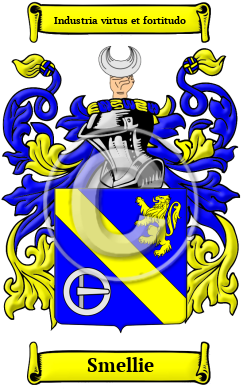
The motto was originally a war cry or slogan. Mottoes first began to be shown with arms in the 14th and 15th centuries, but were not in general use until the 17th century. Thus the oldest coats of arms generally do not include a motto. Mottoes seldom form part of the grant of arms: Under most heraldic authorities, a motto is an optional component of the coat of arms, and can be added to or changed at will; many families have chosen not to display a motto.
Motto: Industria virtus et fortitudo
Motto Translation: Industry, valor, and fortitude.
- Filby, P. William, Meyer, Mary K., Passenger and immigration lists index : a guide to published arrival records of about 500,000 passengers who came to the United States and Canada in the seventeenth, eighteenth, and nineteenth centuries. 1982-1985 Cumulated Supplements in Four Volumes Detroit, Mich. : Gale Research Co., 1985, Print (ISBN 0-8103-1795-8)
- Convict Records Voyages to Australia (Retrieved 16th September 2020). Retrieved from https://convictrecords.com.au/ships/baretto-junior
- New Zealand Yesteryears Passenger Lists 1800 to 1900 (Retrieved 17th October 2018). Retrieved from http://www.yesteryears.co.nz/shipping/passlist.html
- New Zealand Yesteryears Passenger Lists 1800 to 1900 (Retrieved 26th March 2019). Retrieved from http://www.yesteryears.co.nz/shipping/passlist.html
 |