| ![Show Contents]() Siosal History, Family Crest & Coats of Arms Siosal History, Family Crest & Coats of Arms
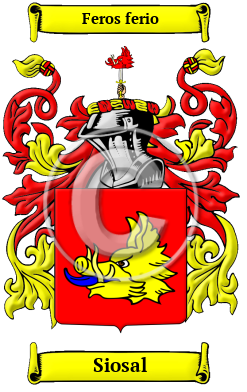
Etymology of SiosalWhat does the name Siosal mean? The roots of the Siosal family are in the Boernician tribe of ancient Scotland. The Siosal family lived in the Barony of Chisolm in the Parish of Roberton, Roxburghshire. The Gaelic form of the name is Siosalach and together the Clan is known as An Siosalach. Siosal Coat of Arms CreationAccording to Scottish lore, it is uncertain if the family came to Inverness-shire from the Borders or from Caithness, but it is claimed that they had the boar's head as their crest before they came. It is said that at one time Glenconvinth was infested with wild boars which were a terror to the people, who, on one occasion, assembled to hunt out the last of them. Among the number was the Master of Chisholm. After sharpening his spear, a young man advanced to kill the animal, which was seen not far off. His courage, however, failed, and then young Chisholm asked to be permitted to attack it. With sharpened spear he went forward undismayed by his antagonist, and, as it was in the act of springing, he pierced the animal in the neck and then stood on the body. Since then, at any rate, the crest of the family is a right hand holding a dagger on the point of which is a boar's head ; and the motto is " Feros ferio " (I strike the fierce). 1 Early Origins of the Siosal familyThe surname Siosal was first found in Roxburghshire, from the barony of Chisholm. One of the first times the name was listed was John de Chesehelme, in Roxburghshire in 1254. Robert de Chesholme was custodian of Urchard Castle in the 1300s. By the mid-14th century, much of the family had moved north: Robert de Chesholme appears as the sheriff of Inverness in 1359. Many feel that Robert was the founder of the Clan. "The first of the name recorded is John de Chesehelme, mentioned in a bull of Pope Alexander IV, 1254. John de Chesolm of Berwickshire, and Richard de Chesehelme of Roxburghshire rendered homage in 1296. The seal of the latter bears on a heater shield, a boar s head, couped, contoume, dropping blood, and S' Ricardi de Cheishelm." 2 Early History of the Siosal familyThis web page shows only a small excerpt of our Siosal research. Another 472 words (34 lines of text) covering the years 1176, 1315, 1348, 1359, 1369, 1439, 1486, 1499, 1512, 1513, 1527, 1561, 1564, 1593, 1603, 1605, 1629, 1647, 1684, 1715, 1785 and 1795 are included under the topic Early Siosal History in all our PDF Extended History products and printed products wherever possible. Siosal Spelling VariationsBoernician names that evolved in the largely preliterate Middle Ages are often marked by considerable spelling variations. Siosal has been spelled Chisholme, Chisum, Chissum, Chissolm, Chissholm, Chisolt, Chism, Chisholm, Chisham, Chiseholm, Chisam and many more. Early Notables of the Siosal familyWilliam Chisholm (d. 1564), Bishop of Dunblane, the second son of Edmund Chisholm of Cromlix, near Dunblane, a son of Chisholm of that Ilk in Rhoxburghshire and half-brother of James Chisholm, who was Bishop of Dunblane from 1486 to 1527, when he resigned his see, with the consent of Pope Clement VII and King James V, in favour of William Chisholm. William Chisholm was consecrated bishop at Stirling on 14 April 1527. 3
Another William Chisholm (d. 1593), was Bishop of Dunblane and Bishop of Vaison, a son of Chisholm of Cromlix, and nephew to William Chisholm, bishop of Dunblane from 1527...
Another 105 words (8 lines of text) are included under the topic Early Siosal Notables in all our PDF Extended History products and printed products wherever possible. Migration of the Siosal family to IrelandSome of the Siosal family moved to Ireland, but this topic is not covered in this excerpt. More information about their life in Ireland is included in all our PDF Extended History products and printed products wherever possible. Migration of the Siosal familySome of the Boernician-Scottish Clan families who came to North America were Loyalists who went north to Canada after the American War of Independence. Families on both sides of the border went on to found two of the world's great nations. This century, families with Scottish roots have rediscovered their heritage through highland games and Clan societies. An inquiry into the early roots of North American families reveals a number of immigrants bearing the name Siosal or a variant listed above: Thomas Chisham who settled in Jamaica in 1774; Alexander Chisholme settled in Georgia in 1735; George Chisom settled in Philadelphia in 1840; Dr. Chisolm settled in Jamaica in 1774.
The motto was originally a war cry or slogan. Mottoes first began to be shown with arms in the 14th and 15th centuries, but were not in general use until the 17th century. Thus the oldest coats of arms generally do not include a motto. Mottoes seldom form part of the grant of arms: Under most heraldic authorities, a motto is an optional component of the coat of arms, and can be added to or changed at will; many families have chosen not to display a motto.
Motto: Feros ferio
Motto Translation: I am fierce with the fiercest
- Polson, Alexander, The Romance of Scottish Crests and Mottoes. Inverness: Walter Alexander, Inglis Street 1929. Print
- Black, George F., The Surnames of Scotland Their Origin, Meaning and History. New York: New York Public Library, 1946. Print. (ISBN 0-87104-172-3)
- Smith, George (ed), Dictionary of National Biography. London: Smith, Elder & Co., 1885-1900. Print
 |