| ![Show Contents]() Singart History, Family Crest & Coats of Arms Singart History, Family Crest & Coats of Arms
- Origins Available:
England
Etymology of SingartWhat does the name Singart mean? Singart is one of the most ancient names to come from the Norman culture that arrived in Britain soon after the Norman Conquest of 1066. It is a name for a person who was a person with lordly bearing, or the older of two people with the same name. The first is by analogy with the French seigneur, meaning lord. Early Origins of the Singart familyThe surname Singart was first found in Norfolk, where the family was granted lands by William the Conqueror for having assisted at the Battle of Hastings in 1066. The earliest known bearer of the name was Walter Seignure, who was recorded in the Pipe Rolls of Norfolk in 1164. Early History of the Singart familyThis web page shows only a small excerpt of our Singart research. Another 176 words (13 lines of text) covering the years 1150, 1164, 1212, 1271, 1382, 1475, 1565, 1845 and 1887 are included under the topic Early Singart History in all our PDF Extended History products and printed products wherever possible. Singart Spelling VariationsIt is only in the last few hundred years that the English language has been standardized. For that reason, Anglo-Norman surnames like Singart are characterized by many spelling variations. Scribes and monks in the Middle Ages spelled names they sounded, so it is common to find several variations that refer to a single person. As the English language changed and incorporated elements of other European languages such as Norman French and Latin, even literate people regularly changed the spelling of their names. The variations of the name Singart include Senior, Sinyeard, Singard, Sinyard, Sinor, Sayner, Saynor, Sayner and many more. Early Notables of the Singart familyAnother 33 words (2 lines of text) are included under the topic Early Singart Notables in all our PDF Extended History products and printed products wherever possible. Migration of the Singart familyFaced with the chaos present in England at that time, many English families looked towards the open frontiers of the New World with its opportunities to escape oppression and starvation. People migrated to North America, as well as Australia and Ireland in droves, paying exorbitant rates for passages in cramped, unsafe ships. Many of the settlers did not make the long passage alive, but those who did see the shores of North America were welcomed with great opportunity. Many of the families that came from England went on to make essential contributions to the emerging nations of Canada and the United States. Some of the first immigrants to cross the Atlantic and come to North America carried the name Singart, or a variant listed above: Eliz Senior, who settled in Virginia in 1666; Jacob Senior, who arrived in Nevis in 1679; Joseph Senior, who arrived in Barbados in 1680 with his four servants, Jane Senior, who came to Virginia in 1728.
The motto was originally a war cry or slogan. Mottoes first began to be shown with arms in the 14th and 15th centuries, but were not in general use until the 17th century. Thus the oldest coats of arms generally do not include a motto. Mottoes seldom form part of the grant of arms: Under most heraldic authorities, a motto is an optional component of the coat of arms, and can be added to or changed at will; many families have chosen not to display a motto.
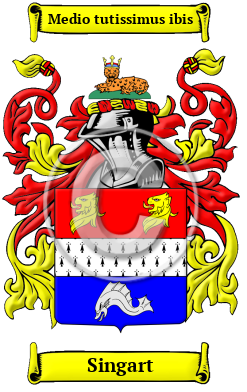
Motto: Medio tutissimus ibis
Motto Translation: Go most safely by the middle course
 |