
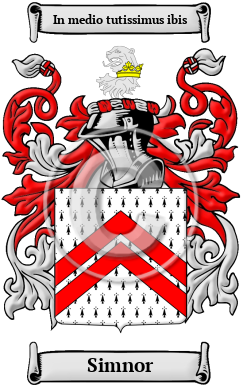
Show ContentsSimnor History, Family Crest & Coats of Arms

Etymology of Simnor

What does the name Simnor mean?

Simnor is an Anglo-Saxon name. The name was originally given to a "summoner", a petty officer who cited and warned people to appear in court. The surname Simnor is derived from the Anglo-French words somenour and sumenour, which in turn were derived from the Old French words somoneor and semoneor, which mean summoner.

Early Origins of the Simnor family

The surname Simnor was first found in Oxfordshire at Bicester where they held a family seat from very ancient times, some say at the time of the Norman Conquest and the arrival of Duke William at Hastings in 1066 A.D.

Early History of the Simnor family

This web page shows only a small excerpt of our Simnor research. Another 118 words (8 lines of text) covering the years 1598, 1635, 1669 and 1848 are included under the topic Early Simnor History in all our PDF Extended History products and printed products wherever possible.

Simnor Spelling Variations

One relatively recent invention that did much to standardize English spelling was the printing press. However, before its invention even the most literate people recorded their names according to sound rather than spelling. The spelling variations under which the name Simnor has appeared include Sumner, Sumners and others.

Early Notables of the Simnor family

Willaim Somner (1598-1669), an Anglo-Saxon scholar, baptised in the church of St. Margaret, Canterbury. His father held the office of registrary of the court of Canterbury, under Sir Nathaniel Brent, commissary. "After passing through the free school at Canterbury, he became clerk to his father, and...
Another 46 words (3 lines of text) are included under the topic Early Simnor Notables in all our PDF Extended History products and printed products wherever possible.

Migration of the Simnor family

At this time, the shores of the New World beckoned many English families that felt that the social climate in England was oppressive and lacked opportunity for change. Thousands left England at great expense in ships that were overcrowded and full of disease. A great portion of these settlers never survived the journey and even a greater number arrived sick, starving, and without a penny. The survivors, however, were often greeted with greater opportunity than they could have experienced back home. These English settlers made significant contributions to those colonies that would eventually become the United States and Canada. An examination of early immigration records and passenger ship lists revealed that people bearing the name Simnor arrived in North America very early: Mary Sumner who settled in Salem, Massachusetts in 1630, along with Elizabeth and Henry; Mary Sumner settled in Virginia in 1653; A. Sumner settled in San Francisco, Cal. in 1850.


The Simnor Motto +

The motto was originally a war cry or slogan. Mottoes first began to be shown with arms in the 14th and 15th centuries, but were not in general use until the 17th century. Thus the oldest coats of arms generally do not include a motto. Mottoes seldom form part of the grant of arms: Under most heraldic authorities, a motto is an optional component of the coat of arms, and can be added to or changed at will; many families have chosen not to display a motto.

Motto: In medio tutissimus ibis
Motto Translation: Thou wilt go safest in the middle.


Houseofnames.com on Facebook