| ![Show Contents]() Simmon History, Family Crest & Coats of Arms Simmon History, Family Crest & Coats of Arms
Etymology of SimmonWhat does the name Simmon mean? Similar to many French family names, the distinguished surname Simmon is a proud sign of a rich and ancient ancestry. The earliest forms of hereditary surnames in France were the patronymic surnames, which are derived from the father's given name, and metronymic surnames, which are derived from the mother's given name. The patronyms were derived from a variety of given names that were of many different origins. As well as the names of the saints of the Christian Church, many of the most common French surnames are derived from personal names of Germanic origin. They derive from the language of the Visigoths, who controlled France between the mid-5th and early 8th centuries. Simmon is derived from the Hebrew personal name Shim'on, meaning to hearken. Early Origins of the Simmon familyThe surname Simmon was first found in Lorraine where they held a family seat and are said to be descended from the first French Simon or Sigismond, the Duke of Lorraine, 1115 A.D. who was succeeded by Simon II in 1179. There is also some distant relationship to Simond, King of Bourgogne. Robert Simon is cited as a knight in 1169. 1 This prolific family dispersed to many parts of France including Kerbringal, Val-au-Houlle, Vallemoisan, Villeneuve and Ligou in Brittany, Plainmarais in Normandie, Quirielle in Bourbonnais, Maine, Laval, Montillemart and Ratisbone. Abbot Honoré-Richard Simon was a noted researcher who died in 1693. Richard Simon was a celebrated orator who died in 1712. Denis Simon was a noted jurist who died in 1731. Antoine Simon was guardian of the dauphin Louis XVII at Temple Prison in 1793. In Britain this surname Simon became the family name of the Viscounts and Barons Simon. Gregoire Simon, born in 1631, son of Jean and Simone (née Bancherelle), travelled to Canada in the 17th century. He married Jeanne Collet, born in 1645, daughter of Michel and Marie (née Henaut), in Montreal, Quebec on 31st December 1668. They settled together in Montreal until they passed away on 8th May 1691. 2 Early History of the Simmon familyThis web page shows only a small excerpt of our Simmon research. The years 1638 and 1712 are included under the topic Early Simmon History in all our PDF Extended History products and printed products wherever possible. Simmon Spelling VariationsSpelling variations of this family name include: Simon, Simond, Simmon, Simmond, Simeon, Simmeon, Simian, Simiane, Simmiane, Simmian, Le Simon, Simmonde, Simonde, Simont, Simonte, De Simon, Du Simon, du Simon, de Simon, Simons, Simmonne, Simmonet and many more. Early Notables of the Simmon familyMore information is included under the topic Early Simmon Notables in all our PDF Extended History products and printed products wherever possible. Simmon RankingIn the United States, the name Simmon is the 7,366th most popular surname with an estimated 4,974 people with that name. 3
| Simmon migration to the United States | + |
Simmon Settlers in United States in the 18th Century- Johann Simmon, who landed in Pennsylvania in 1752 4
- Peter Simmon, who arrived in Pennsylvania in 1752 4
| Contemporary Notables of the name Simmon (post 1700) | + |
- Robert Simmon, American Senior Data Visualization Engineer at Planet Labs, a commercial Earth observation company in San Francisco
The motto was originally a war cry or slogan. Mottoes first began to be shown with arms in the 14th and 15th centuries, but were not in general use until the 17th century. Thus the oldest coats of arms generally do not include a motto. Mottoes seldom form part of the grant of arms: Under most heraldic authorities, a motto is an optional component of the coat of arms, and can be added to or changed at will; many families have chosen not to display a motto.
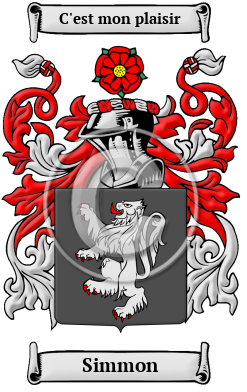
Motto: C'est mon plaisir
Motto Translation: It is my pleasure.
- Hozier, Charles D, and Antoine Bachelin-Delforenne. État présent De La Noblesse française (1883-1887): Contenant Le Distionnaire De La Noblesse Contemporaine Et Larmorial général De France, Dapres Les Manuscrits De Ch. D Hozier. Librairie Des Bibliophiles, 1884. Print.
- Olivier, Reginald L. Your Ancient Canadian Family Ties. Logan: The Everton Publishers, Inc., P.O. Box 368, 1972. Print
- "What are the 5,000 Most Common Last Names in the U.S.?". NameCensus.com, https://namecensus.com/last-names/
- Filby, P. William, Meyer, Mary K., Passenger and immigration lists index : a guide to published arrival records of about 500,000 passengers who came to the United States and Canada in the seventeenth, eighteenth, and nineteenth centuries. 1982-1985 Cumulated Supplements in Four Volumes Detroit, Mich. : Gale Research Co., 1985, Print (ISBN 0-8103-1795-8)
 |