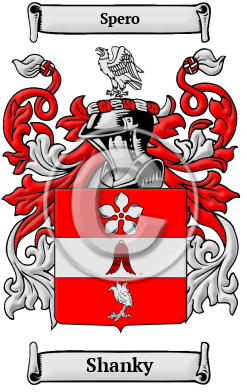
| ![Show Contents]() Shanky History, Family Crest & Coats of Arms Shanky History, Family Crest & Coats of Arms
Etymology of ShankyWhat does the name Shanky mean? The ancestors of the first family in ancient Scotland to use the name Shanky lived among the Boernicians. Shanky is a name for a person with long legs, or a peculiar manner of gait. Shanky is a nickname, which belongs to the category of hereditary surnames. Nicknames form a broad and miscellaneous class of surnames, and can refer directly or indirectly to one's personality, physical attributes, mannerisms, or even their habits of dress. It derives from the Old English word sceanca, which means shin bone, or leg. While this word has survived in Scotland, it has been replaced in England, by the Old Norse word leggr, which means leg. "Shank, in Scotland, is a topographical word, meaning the projecting point of a hill. The family existed in early times in Mid-Lothian, the founder being Murdoch Schank, who is said to have discovered, and taken charge of, the body of Alexander III., King of Scotland, who met his death while hunting in 1286. For this service, Robert Bruce presented him with the lands of Castlerigg." 1 Early Origins of the Shanky familyThe surname Shanky was first found in Midlothian, from the lands of Shank, where the family held a family seat from very ancient times. 2 3 They were designated as 'Shank of that Ilk" meaning an ancient Clan who possessed lands of that same name. Murdoch Shank, son of the first recorded chief of the Clan of Shank in Midlothian, was granted the lands of Kinghorn in Fife by a Charter from King Robert the Bruce of Scotland in the year 1319 for his allegiance and loyalty of the Clan in his fight for the crown of Scotland. 4 "Thomas Schankis witnessed a charter in the Castle of Cumnock, 1426, and in 1474 John de Schankis appears as charter witness in Glasgow. Stene Schanx, witness in Lanark. 1488, appears two years later as Stene Synkis, and in 1489 James Schankis had remission for his part in holding Dunbertane Castle against the king." 4 Early History of the Shanky familyThis web page shows only a small excerpt of our Shanky research. Another 209 words (15 lines of text) covering the years 1426, 1489, 1490, 1503, 1508, 1595, 1599, 1620, 1630, 1635, 1636, 1643, 1712, 1725, 1740, 1758, 1766, 1771, 1776, 1823 and 1890 are included under the topic Early Shanky History in all our PDF Extended History products and printed products wherever possible. Shanky Spelling VariationsOver the years, Shanky has been written It appears under these variations because medieval scribes spelled names according to sound rather than by any over-arching set of rules. Shank, Shanke, Schank, Schanke, Shankis, Schankis, Shanks, Shanx, Schanx and many more. Early Notables of the Shanky familyJohn Shank, also spelled Shanke or Shanks (died 1636), an actor in English Renaissance theatre, a leading comedian in the King's Men during the 1620s and 1630s. A long time resident in St. Giles's, Cripplegate, "he speaks of himself in 1635 as an old man, and affirms that he was originally in the company of Lord Pembroke, and afterwards in the companies of Queen Elizabeth, James I, and Charles I. This would place his first appearance in the sixteenth century. " 5
John Schank (1740-1823), the Scottish admiral, born in 1740, son of Alexander Schanck of Castlereg, Fifeshire, first went to sea...
Another 153 words (11 lines of text) are included under the topic Early Shanky Notables in all our PDF Extended History products and printed products wherever possible. Migration of the Shanky family to IrelandSome of the Shanky family moved to Ireland, but this topic is not covered in this excerpt.
Another 60 words (4 lines of text) about their life in Ireland is included in all our PDF Extended History products and printed products wherever possible. Migration of the Shanky familyWhen these Boernician-Scottish settlers arrived in North America they brought little with them and often had restart their lives from scratch. Through time, much of their heritage was lost, and it is only this century through Clan societies and highland games that many have recovered their national heritage. Research into various historical records has revealed some of first members of the Shanky family to immigrate North America: Stephen Shank settled in Barbados in 1663; John George Shank arrived in Pennsylvania in 1770; John Shanks settled in Virginia in 1650; another John Shanks arrived in Virginia in 1734.
The motto was originally a war cry or slogan. Mottoes first began to be shown with arms in the 14th and 15th centuries, but were not in general use until the 17th century. Thus the oldest coats of arms generally do not include a motto. Mottoes seldom form part of the grant of arms: Under most heraldic authorities, a motto is an optional component of the coat of arms, and can be added to or changed at will; many families have chosen not to display a motto.
Motto: Spero
Motto Translation: I hope.
- Lower, Mark Anthony, Patronymica Britannica, A Dictionary of Family Names of the United Kingdom. London: John Russel Smith, 1860. Print.
- Smith, Eldson Coles, New Dictionary of American Family Names New York: Harper & Row, 1956. Print
- Guppy, Henry Brougham, Homes of Family Names in Great Britain. 1890. Print.
- Black, George F., The Surnames of Scotland Their Origin, Meaning and History. New York: New York Public Library, 1946. Print. (ISBN 0-87104-172-3)
- Smith, George (ed), Dictionary of National Biography. London: Smith, Elder & Co., 1885-1900. Print
 |