
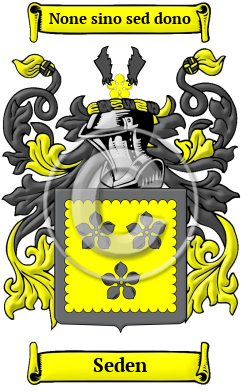
Show ContentsSeden History, Family Crest & Coats of Arms

Etymology of Seden

What does the name Seden mean?

Of all the Anglo-Saxon names to come from Britain, Seden is one of the most ancient. The name is a result of the original family having lived in Seddon found in south-west Lancashire.

Early Origins of the Seden family

The surname Seden was first found in Durham where they held a family seat from early times and their first records appeared on the early census rolls taken by the early Kings of Britain to determine the rate of taxation of their subjects.

Early History of the Seden family

This web page shows only a small excerpt of our Seden research. Another 84 words (6 lines of text) covering the years 1644 and 1700 are included under the topic Early Seden History in all our PDF Extended History products and printed products wherever possible.

Seden Spelling Variations

The first dictionaries that appeared in the last few hundred years did much to standardize the English language. Before that time, spelling variations in names were a common occurrence. The language was changing, incorporating pieces of other languages, and the spelling of names changed with it. Seden has been spelled many different ways, including Seddon, Seddan, Sedden and others.

Early Notables of the Seden family

Another 50 words (4 lines of text) are included under the topic Early Seden Notables in all our PDF Extended History products and printed products wherever possible.


Seden migration to West Indies +

The British first settled the British West Indies around 1604. They made many attempts but failed in some to establish settlements on the Islands including Saint Lucia and Grenada. By 1627 they had managed to establish settlements on St. Kitts (St. Christopher) and Barbados, but by 1641 the Spanish had moved in and destroyed some of these including those at Providence Island. The British continued to expand the settlements including setting the First Federation in the British West Indies by 1674; some of the islands include Barbados, Bermuda, Cayman Island, Turks and Caicos, Jamaica and Belize then known as British Honduras. By the 1960's many of the islands became independent after the West Indies Federation which existed from 1958 to 1962 failed due to internal political conflicts. After this a number of Eastern Caribbean islands formed a free association. 1
Seden Settlers in West Indies in the 17th Century
  • Mr. Nicolas Seden, (b. 1615), aged 20, British settler traveling aboard the ship "Paul of London" arriving in St Christopher (Saint Kitts) in 1635 2


The Seden Motto +

The motto was originally a war cry or slogan. Mottoes first began to be shown with arms in the 14th and 15th centuries, but were not in general use until the 17th century. Thus the oldest coats of arms generally do not include a motto. Mottoes seldom form part of the grant of arms: Under most heraldic authorities, a motto is an optional component of the coat of arms, and can be added to or changed at will; many families have chosen not to display a motto.

Motto: None sino sed dono
Motto Translation: I do not permit, but I give.


  1. https://en.wikipedia.org/wiki/British_West_Indies
  2. Pilgrim Ship's of 1600's (Retrieved October 4th 2021 from https://www.packrat-pro.com/ships/shiplist.htm


Houseofnames.com on Facebook