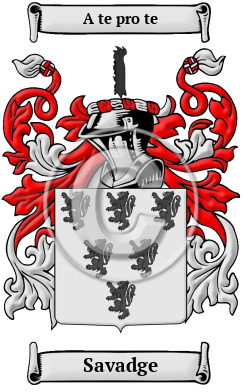
| ![Show Contents]() Savadge History, Family Crest & Coats of Arms Savadge History, Family Crest & Coats of Arms
Early Origins of the Savadge familyThe surname Savadge was first found in "Normandy and England, which implied, perhaps, a roughness of manners." 1 John Sauuage, was a witness in 1222, James Seavage was married in Edinburgh in 1629, and John Savadge appears in the toun of Sanquhar in 1641. 2 Selvach (died 729), was king of Scottish Dalriada and was probably a younger son of Fearchair Fada (the Long.) 3 Early History of the Savadge familyThis web page shows only a small excerpt of our Savadge research. Another 116 words (8 lines of text) covering the years 1177 and 1890 are included under the topic Early Savadge History in all our PDF Extended History products and printed products wherever possible. Savadge Spelling VariationsSpelling variations of this family name include: Savage, Sauvage, Savidge, Savadge and others. Early Notables of the Savadge familyMore information is included under the topic Early Savadge Notables in all our PDF Extended History products and printed products wherever possible. Migration of the Savadge family to IrelandSome of the Savadge family moved to Ireland, but this topic is not covered in this excerpt.
Another 74 words (5 lines of text) about their life in Ireland is included in all our PDF Extended History products and printed products wherever possible.
| Savadge migration to the United States | + |
Savadge Settlers in United States in the 17th Century- Hannah Savadge, who arrived in Virginia in 1621 4
- Robart Savadge, aged 18, who arrived in Virginia in 1621 aboard the ship "Elizabeth" 4
- Mrs. Savadge, who landed in Virginia in 1621 4
- Thomas Savadge, aged 19, British settler who arrived in Virginia in 1623 aboard the ship "Ambrose" 4
- Robert Savadge, who settled in Virginia in 1623
- ... (More are available in all our PDF Extended History products and printed products wherever possible.)
Savadge Settlers in United States in the 18th Century- Dorothy Savadge, who arrived in Virginia in 1703 4
- William Savadge, who landed in Virginia in 1706 4
The motto was originally a war cry or slogan. Mottoes first began to be shown with arms in the 14th and 15th centuries, but were not in general use until the 17th century. Thus the oldest coats of arms generally do not include a motto. Mottoes seldom form part of the grant of arms: Under most heraldic authorities, a motto is an optional component of the coat of arms, and can be added to or changed at will; many families have chosen not to display a motto.
Motto: A te pro te
Motto Translation: From thee, for thee.
- Lower, Mark Anthony, Patronymica Britannica, A Dictionary of Family Names of the United Kingdom. London: John Russel Smith, 1860. Print.
- Black, George F., The Surnames of Scotland Their Origin, Meaning and History. New York: New York Public Library, 1946. Print. (ISBN 0-87104-172-3)
- Smith, George (ed), Dictionary of National Biography. London: Smith, Elder & Co., 1885-1900. Print
- Filby, P. William, Meyer, Mary K., Passenger and immigration lists index : a guide to published arrival records of about 500,000 passengers who came to the United States and Canada in the seventeenth, eighteenth, and nineteenth centuries. 1982-1985 Cumulated Supplements in Four Volumes Detroit, Mich. : Gale Research Co., 1985, Print (ISBN 0-8103-1795-8)
 |