
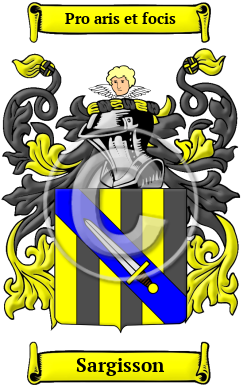
Show ContentsSargisson History, Family Crest & Coats of Arms

Early Origins of the Sargisson family

The surname Sargisson was first found in Yorkshire where they held a family seat from very ancient times, some say, soon after the Norman Conquest of England in 1066 A.D.

Early History of the Sargisson family

This web page shows only a small excerpt of our Sargisson research. Another 103 words (7 lines of text) covering the years 1654, 1671, 1675, 1732, 1803, 1827 and 1969 are included under the topic Early Sargisson History in all our PDF Extended History products and printed products wherever possible.

Sargisson Spelling Variations

Spelling variations of this family name include: Sargentson, Sergentson, Sergenton, Sergeantson, Sargeuntson, Sargeantson, Sargantson, Serjeantson, Serjentson, Sergjantson, Sargeaton and many more.

Early Notables of the Sargisson family

Charles Sergison (1654-1732), Commissioner of the Navy. He entered the service of the crown as a dockyard clerk in July 1671. In 1675 he became clerk to the Clerk...
Another 28 words (2 lines of text) are included under the topic Early Sargisson Notables in all our PDF Extended History products and printed products wherever possible.

Migration of the Sargisson family to Ireland

Some of the Sargisson family moved to Ireland, but this topic is not covered in this excerpt. More information about their life in Ireland is included in all our PDF Extended History products and printed products wherever possible.

Migration of the Sargisson family

Some of the first settlers of this family name or some of its variants were: John Sargeaton, who settled in Virginia in the year 1700 with his wife and child.


Contemporary Notables of the name Sargisson (post 1700) +

  • Tony Sargisson (b. 1975), New Zealand silver medalist in the men's 50km walk at the 2006 Melbourne Commonwealth Games


The Sargisson Motto +

The motto was originally a war cry or slogan. Mottoes first began to be shown with arms in the 14th and 15th centuries, but were not in general use until the 17th century. Thus the oldest coats of arms generally do not include a motto. Mottoes seldom form part of the grant of arms: Under most heraldic authorities, a motto is an optional component of the coat of arms, and can be added to or changed at will; many families have chosen not to display a motto.

Motto: Pro aris et focis
Motto Translation: For our altars and our home.


Houseofnames.com on Facebook