
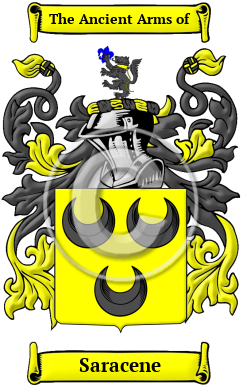
Show ContentsSaracene History, Family Crest & Coats of Arms

Etymology of Saracene

What does the name Saracene mean?

The Saracene surname is derived from the Old French word "Sarrazin," meaning "Saracen." It is thought to have been a nickname in Medieval England for someone of swarthy appearance, or for someone returned from the Crusades, before becoming a surname.

Early Origins of the Saracene family

The surname Saracene was first found in Cumberland where they held a family seat as Lords of the Manor. The Saxon influence of English history diminished after the Battle of Hastings in 1066. The language of the courts was French for the next three centuries and the Norman ambience prevailed. But Saxon surnames survived and the family name was first referenced in the 13th century when they held estates in that county.

Early History of the Saracene family

This web page shows only a small excerpt of our Saracene research. Another 81 words (6 lines of text) covering the years 1285, 1327, 1455 and 1487 are included under the topic Early Saracene History in all our PDF Extended History products and printed products wherever possible.

Saracene Spelling Variations

Until the dictionary, an invention of only the last few hundred years, the English language lacked any comprehensive system of spelling rules. Consequently, spelling variations in names are frequently found in early Anglo-Saxon and later Anglo-Norman documents. One person's name was often spelled several different ways over a lifetime. The recorded variations of Saracene include Sarson, Sarsen, Saracen, Sarason, Sareson and many more.

Early Notables of the Saracene family

More information is included under the topic Early Saracene Notables in all our PDF Extended History products and printed products wherever possible.

Migration of the Saracene family

Thousands of English families boarded ships sailing to the New World in the hope of escaping the unrest found in England at this time. Although the search for opportunity and freedom from persecution abroad took the lives of many because of the cramped conditions and unsanitary nature of the vessels, the opportunity perceived in the growing colonies of North America beckoned. Many of the settlers who survived the journey went on to make important contributions to the transplanted cultures of their adopted countries. The Saracene were among these contributors, for they have been located in early North American records: Rich Sarson, who was on record in Virginia in 1654; Thomas Sarson, who came to Virginia in 1656; as well as Hans Peter Sarson, who was naturalized in Illinois in 1891..


Houseofnames.com on Facebook
