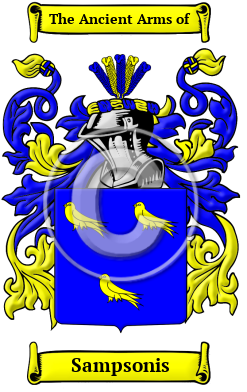
| ![Show Contents]() Sampsonis History, Family Crest & Coats of Arms Sampsonis History, Family Crest & Coats of Arms
- Origins Available:
France
Etymology of SampsonisWhat does the name Sampsonis mean? The name Sampsonis is from Normandy, France. The root name Sanson or Samson is an Old French name given to "a Welsh bishop (fl. 550) who crossed over to Brittany and founded the abbey of Dol where he was buried and venerated as a saint. Whether his name is the Biblical Samson or one of Celtic origin is uncertain. Probably from Saint-Samson (Seine-Inférieure), or from Saint-Samson (Calvados), Saint-Samson-de-Bonfosse (La Manche) or Saint-Samson-de-la-Roque (Eure)." 1 Another source claims the name to be derived from the Hebrew given name Shemuel, meaning the name of God. Early Origins of the Sampsonis familyThe surname Sampsonis was first found in Normandy (French: Normandie), the former Duchy of Normandy, where this distinguished family held a family seat at Saint-Clair-Sur-Elle in Manche in the arrondissement of St.Lô, where one Ricardi Samsonis, the Latin name for Richard Sampson is described in a charter to Philip the Bishop of Bayeux in 1142, and he is named as occupant of the castle of Saint-Clair. 2 "A well-known monastery near Rouen was built by the Archbishop of Dol, known as St. Sansone or St. Sampson." 3 Early History of the Sampsonis familyThis web page shows only a small excerpt of our Sampsonis research. Another 56 words (4 lines of text) are included under the topic Early Sampsonis History in all our PDF Extended History products and printed products wherever possible. Sampsonis Spelling VariationsOne can encounter great variation in the spelling of French surnames; in part, as spelling, and the spelling names was not yet standardized during the early development of the written French language. Later, there was much branching and movement of families, and spellings would change according to region. Variations of the name Sampsonis include Samson, Samsons, Samsone, Samso, Samsun, Samsoen, Sampsoen, Sampson, Sampsonis and many more. Early Notables of the Sampsonis familyMore information is included under the topic Early Sampsonis Notables in all our PDF Extended History products and printed products wherever possible. Migration of the Sampsonis familyFrench settlers came early to North American, following in the wake of the explorers, and creating New France. Quebec City, founded in 1608 by Samuel de Champlain is said to have been the first American site founded as a permanent settlement, rather than as just a commercial outpost. But emigration was slow, in 1643, 109 years after the first landings by Cartier, there were only about 300 French people in Quebec, and by 1663, when the region was officially made The Royal Colony of New France, by Louis XIV, there still only around 500 settlers. Over 2,000 would arrive during the next decade. Early marriage was desperately encouraged amongst the immigrants. Youths of 18 took fourteen-year-old girls for their wives. The fur trade was developed and attracted immigrants, both noble and commoner from France. By 1675, there were around 7000 French in the colony, and by that same year the Acadian presence in Nova Scotia, New Brunswick and Prince Edward Island had reached 500. In 1755, 10,000 French Acadians refused to take an oath of allegiance to England and were deported to Louisiana. Despite the loss of the Colony to England, the French people flourished in Lower Canada. Among settlers to North America of the Sampsonis surname were Henry Samson who settled in Plymouth, Massachusetts in 1620; Charlemagne Samson settled in New Orleans La. in 1823; Samuel Samson landed in New York State in 1849 with his wife and four children.
- Reaney, P.H and R.M. Wilson, A Dictionary of English Surnames. London: Routledge, 1991. Print. (ISBN 0-415-05737-X)
- The Norman People and Their Existing Descendants in the British Dominions and the United States Of America. Baltimore: Genealogical Publishing, 1975. Print. (ISBN 0-8063-0636-X)
- Bardsley, C.W, A Dictionary of English and Welsh Surnames: With Special American Instances. Wiltshire: Heraldry Today, 1901. Print. (ISBN 0-900455-44-6)
 |