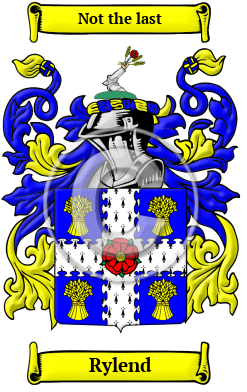
| ![Show Contents]() Rylend History, Family Crest & Coats of Arms Rylend History, Family Crest & Coats of Arms
Etymology of RylendWhat does the name Rylend mean? The name Rylend reached England in the great wave of migration following the Norman Conquest of 1066. The Rylend family lived in Lincolnshire at Ryland, a hamlet, in the parish of Welton, wapentake of Lawress, parts of Lindsey. 1 This name is a topographical reference to land owned by the Rye family in this county. Rye is also topographical and indicates that the original bearer of the name lived near to a field of rye, and was distinguished by this proximity. Mr. J. Paul Rylands, F.S.A., says the name 'Ryelands is derived from the Anglo-Saxon rye or rhee, a water-course or stream, and lands, the lands adjoining or above the stream.' Early Origins of the Rylend familyThe surname Rylend was first found in Lancashire where Robert del Ruylondes, of West Halghton was recorded 1 Edward III. The same source notes William de Rylondes, of Halghton, 6 Edward III and Nicholas del Rylondes, 1436. 2 Another source notes Stephen de Riland in c. 1232-1245 and John de Rylaundes in the Assize Rolls for Lancashire in 1281. Later in Cheshire, Thomas de Rilond was listed in the Assize Rolls c. 1296. 3 Early History of the Rylend familyThis web page shows only a small excerpt of our Rylend research. Another 179 words (13 lines of text) covering the years 1500, 1723, 1753, 1759, 1760, 1767, 1769, 1771, 1781, 1782, 1786, 1792, 1822, 1825 and 1838 are included under the topic Early Rylend History in all our PDF Extended History products and printed products wherever possible. Rylend Spelling VariationsBefore the advent of the printing press and the first dictionaries, the English language was not standardized. Sound was what guided spelling in the Middle Ages, so one person's name was often recorded under several variations during a single lifetime. Spelling variations were common, even among the names of the most literate people. Known variations of the Rylend family name include Ryland, Roylance, Rylander, Rilands, Rylands and others. Early Notables of the Rylend familyJohn Collett Ryland (1723-1792), English divine, son of Joseph Ryland, a farmer and grazier of Lower Ditchford, Gloucestershire, and grandson of John Ryland, yeoman, of Hinton-on-the-Green, Gloucestershire, born at Bourton-on-the-Water in the same county on 12 Oct. 1723. In October 1759 Ryland left Warwick for Northampton, where he lived twenty-six years as minister and schoolmaster, his pupils often numbering as many as ninety. Ryland died at Enfield on 24 July 1792, and was buried at Northampton, his funeral sermon (two editions, 1792) being preached by Dr. John Rippon. 4
John Ryland (1753-1825), Baptist minister, son of John Collett Ryland [q. v.], was...
Another 221 words (16 lines of text) are included under the topic Early Rylend Notables in all our PDF Extended History products and printed products wherever possible. Migration of the Rylend family to IrelandSome of the Rylend family moved to Ireland, but this topic is not covered in this excerpt. More information about their life in Ireland is included in all our PDF Extended History products and printed products wherever possible. Migration of the Rylend familyTo escape the political and religious chaos of this era, thousands of English families began to migrate to the New World in search of land and freedom from religious and political persecution. The passage was expensive and the ships were dark, crowded, and unsafe; however, those who made the voyage safely were encountered opportunities that were not available to them in their homeland. Many of the families that reached the New World at this time went on to make important contributions to the emerging nations of the United States and Canada. Research into various historical records has revealed some of first members of the Rylend family to immigrate North America: Thomas Ryland, who settled in Virginia in 1650; Thomas Ryland settled in Maryland in 1684; William Ryland settled in Maryland in 1731; John Ryland settled in Philadelphia in 1774. Octavius Ryland (c.1800-1886) was an English convict transported to Western Australia, arriving at Fremantle on board the ".
The motto was originally a war cry or slogan. Mottoes first began to be shown with arms in the 14th and 15th centuries, but were not in general use until the 17th century. Thus the oldest coats of arms generally do not include a motto. Mottoes seldom form part of the grant of arms: Under most heraldic authorities, a motto is an optional component of the coat of arms, and can be added to or changed at will; many families have chosen not to display a motto.
Motto: Not the last
- Lewis, Samuel, A Topographical Dictionary of England. Institute of Historical Research, 1848, Print.
- Bardsley, C.W, A Dictionary of English and Welsh Surnames: With Special American Instances. Wiltshire: Heraldry Today, 1901. Print. (ISBN 0-900455-44-6)
- Reaney, P.H and R.M. Wilson, A Dictionary of English Surnames. London: Routledge, 1991. Print. (ISBN 0-415-05737-X)
- Smith, George (ed), Dictionary of National Biography. London: Smith, Elder & Co., 1885-1900. Print
 |