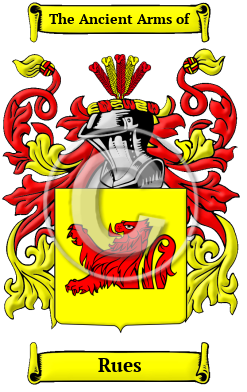
| ![Show Contents]() Rues History, Family Crest & Coats of Arms Rues History, Family Crest & Coats of Arms
Etymology of RuesWhat does the name Rues mean? The name Rues dates back to the days of Medieval France, in the region of Normandy. It is derived from their residence in Normandy. However, the name Ruell is derived from the Old French word ruelle, meaning lane or alley, and indicates that the original bearer lived in such a place. Early Origins of the Rues familyThe surname Rues was first found in Normandy (French: Normandie), the former Duchy of Normandy, where this eminent family held a family seat in the honor of the seigneurie of Launay. This north country family lived almost exclusively in the provinces of Normandy, Brittany, Picardy, Artois, and Flanders. Early History of the Rues familyThis web page shows only a small excerpt of our Rues research. Another 59 words (4 lines of text) covering the years 1452, 1518, 1570, 1625, 1630, 1643, 1658, 1725 and 1785 are included under the topic Early Rues History in all our PDF Extended History products and printed products wherever possible. Rues Spelling VariationsThere were a great number of spelling variations in French surnames. One reason for this was the wide variety of cultural influences present in France during the early development of the French language. The many spelling variations of the name include Rueil, Ruel, de Ruel, De Ruel, du Ruel, Du Ruel, Ruell, Ruelle, Ruelles, Desruelles, de Ruell, De Ruell, Rueil, Rueill, Roulier and many more. Early Notables of the Rues familyPierre de la Rue (c.1452-1518), a Franco-Flemish composer and singer of the Renaissance; Pieter de Ruelles (1630-1658), a Dutch Golden Age landscape painter who died young; and Charles de La Rue (1643-1725), known in Latin as Carolus Ruaeus, one of the great orators of the Society of...
Another 47 words (3 lines of text) are included under the topic Early Rues Notables in all our PDF Extended History products and printed products wherever possible.
| Rues migration to the United States | + |
In 1643, 109 years after the first landings by Cartier, there were only about 300 people in Quebec, in 1663 there were only 500, 2,000 migrants arrived during the next decade. Early marriage was desperately encouraged amongst the immigrants. Youths of 18 took fourteen-year-old girls for their wives. The fur trade was developed and attracted migrants, both noble and commoner from France. 15,000 explorers left Montreal in the late 17th and 18th centuries. Migration from France to New France or Quebec as it was now more popularly called, continued from France until it fell in 1759. By 1675, there were 7000 French in Quebec. By the same year the Acadian presence in Nova Scotia, New Brunswick and Prince Edward Island had reached 500. In 1755, 10,000 French Acadians refused to take an oath of allegiance to England and were deported to Louisiana. Meanwhile, in Quebec, the French race flourished, founding in Lower Canada, one of the two great solitudes which became Canada. Many distinguished contributions have been made by members of this family name Rues. It has been prominent in the arts, religion, politics and culture in France and New France. Amongst the settlers in North America with this distinguished name Rues were
Rues Settlers in United States in the 18th Century- Ludwig Rues, who landed in New York, NY in 1710 1
- Filby, P. William, Meyer, Mary K., Passenger and immigration lists index : a guide to published arrival records of about 500,000 passengers who came to the United States and Canada in the seventeenth, eighteenth, and nineteenth centuries. 1982-1985 Cumulated Supplements in Four Volumes Detroit, Mich. : Gale Research Co., 1985, Print (ISBN 0-8103-1795-8)
 |