| ![Show Contents]() Ross's History, Family Crest & Coats of Arms Ross's History, Family Crest & Coats of Arms
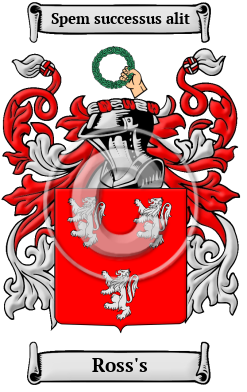
Etymology of Ross'sWhat does the name Ross's mean? The root of the ancient Dalriadan-Scottish name Ross's is the given name Andrew, which is derived from Anrias, a progenitor of both the Ross Clan and the MacKenzies. Anrias was descended from the O'Beolans, an Irish Gaelic tribe of the sixth and seventh centuries who first brought Christianity to Scotland. The name may also be a nickname derived from the Old English word rouse, which means red or red-haired. Ross's Coat of Arms CreationIn the Ross shield there are three lions, to show that they are of Scottish descent. One branch also had a bend charged with buckles, to show that at one time there must have been an alliance with the Leslies. The crest most commonly used by the Ross Clan is a hand holding a garland of laurel, and the motto, " Spem successus alit " (Success nourishes hope). 1 Early Origins of the Ross's familyThe surname Ross's was first found in the old monastery of Applecross founded by St. Maelrubha where they were hereditary abbots who later created the Earls of Ross. Their territory was Faster Ross and the first documented Chief was Fearchar Mac ant-Saqairt (a Farquhar), the priest's son, who helped King Alexander II against the old Celtic dynasty. Farquhar joined forces with the King to crush a rebellion in the province of Moray in 1215. Even though he was a direct descendent of the Irish King Niall of the Nine Hostages, he was granted a Norman knighthood by King Alexander and, a few years later, the Earldom of Ross (1234). At this time, Tain, an early shrine created by St. Dutlac, was the capital of Ross. Now a ruin, it played an important role in Scotland's religious history during the Middle Ages. In the late 15th and early 16th century King James IV made annual pilgrimages there. However, battered by its enemies, and many of its relics destroyed by changing religious influences, the capital was transferred to the town of Dingwall. Early History of the Ross's familyThis web page shows only a small excerpt of our Ross's research. Another 287 words (20 lines of text) covering the years 1372, 1390, 1400, 1600, 1656, 1682, 1715, 1745 and 1890 are included under the topic Early Ross's History in all our PDF Extended History products and printed products wherever possible. Ross's Spelling VariationsHistorical recordings of the name Ross's include many spelling variations. They include They are the result of repeated translations of the name from Gaelic to English and inconsistencies in spelling rules. Ros, Roose, Ross, Ruse and others. Early Notables of the Ross's familyWilliam, 5th Earl of Ross (died 1372); Euphemia, William's daughter became a heiress who carried the title by marriage to Sir Walter Leslie, the title passed to the Lord of the Isles through their son; Sir Andrew Leslie, though before that event, the Chiefship of the Clan passed to...
Another 48 words (3 lines of text) are included under the topic Early Ross's Notables in all our PDF Extended History products and printed products wherever possible. Migration of the Ross's family to IrelandSome of the Ross's family moved to Ireland, but this topic is not covered in this excerpt.
Another 60 words (4 lines of text) about their life in Ireland is included in all our PDF Extended History products and printed products wherever possible. Migration of the Ross's familyDescendents of Dalriadan-Scottish families still populate many communities across North America. They are particularly common in Canada, since many went north as United Empire Loyalists at the time of the American War of Independence. Much later, in the late 19th and early 20th centuries, the highland games and Clan societies that now dot North America sprang up, allowing many Scots to recover their lost national heritage. Some of the first immigrants to cross the Atlantic and come to North America bore the name Ross's, or a variant listed above: Alexander Ross, 32 years old who with his family arrived in New York in 1774; Ann Ross, who arrived in New York in 1774; Johannes Ross who arrived in Pennsylvania in 1754.
The motto was originally a war cry or slogan. Mottoes first began to be shown with arms in the 14th and 15th centuries, but were not in general use until the 17th century. Thus the oldest coats of arms generally do not include a motto. Mottoes seldom form part of the grant of arms: Under most heraldic authorities, a motto is an optional component of the coat of arms, and can be added to or changed at will; many families have chosen not to display a motto.
Motto: Spem successus alit
Motto Translation: Success nourishes hope
- Polson, Alexander, The Romance of Scottish Crests and Mottoes. Inverness: Walter Alexander, Inglis Street 1929. Print
 |