| ![Show Contents]() Roda History, Family Crest & Coats of Arms Roda History, Family Crest & Coats of Arms
Early Origins of the Roda familyThe surname Roda was first found in Northumberland where they held a family seat at Roddam Hall since 1296 when William Roddam had the hall built. "Roddam Hall is a handsome modern mansion, standing on a bold eminence which on the north forms the bank of a deep romantic dell watered by a tributary of the Till. A stone coffin and an urn were dug up here in 1796." 1 John of Roddam held land in Little Houghton in 1337. The Roddam family has held the hall until at least 1776 when it was owned by Admiral Robert Roddam (1719-1808). Roddam is derived from the Old English word "rod" which means "clearing" 2. Alternatively, the name could have been derived from the place name Rodden in Shropshire. There is also a Rodden River in Shropshire. Early History of the Roda familyThis web page shows only a small excerpt of our Roda research. Another 127 words (9 lines of text) covering the years 1200, 1461, 1491, 1591, 1755 and 1890 are included under the topic Early Roda History in all our PDF Extended History products and printed products wherever possible. Roda Spelling VariationsSpelling variations of this family name include: Roddam, Rodden, Roddan, Roddin, Rodan and others. Early Notables of the Roda familyAnother 27 words (2 lines of text) are included under the topic Early Roda Notables in all our PDF Extended History products and printed products wherever possible. Roda RankingIn France, the name Roda is the 5,427th most popular surname with an estimated 1,000 - 1,500 people with that name. 3 Migration of the Roda family to IrelandSome of the Roda family moved to Ireland, but this topic is not covered in this excerpt.
Another 89 words (6 lines of text) about their life in Ireland is included in all our PDF Extended History products and printed products wherever possible.
| Roda migration to the United States | + |
Roda Settlers in United States in the 19th Century- A Roda, aged 25, who arrived in New Orleans, La in 1835 4
| Roda migration to New Zealand | + |
Emigration to New Zealand followed in the footsteps of the European explorers, such as Captain Cook (1769-70): first came sealers, whalers, missionaries, and traders. By 1838, the British New Zealand Company had begun buying land from the Maori tribes, and selling it to settlers, and, after the Treaty of Waitangi in 1840, many British families set out on the arduous six month journey from Britain to Aotearoa to start a new life. Early immigrants include: Roda Settlers in New Zealand in the 19th Century- Albert Roda, (Rhock), aged 30, a Polish farm labourer, who arrived in Wellington, New Zealand aboard the ship "Cartvale" in 1874
- Marianne Roda, (Rhock), aged 33, (d. 1925), Polish settler who arrived in Wellington, New Zealand aboard the ship "Cartvale" in 1874
- Julianne Roda, (Rhock), aged 4, Polish settler who arrived in Wellington, New Zealand aboard the ship "Cartvale" in 1874
- Johan Roda, (Rhock), aged 3, Polish settler who arrived in Wellington, New Zealand aboard the ship "Cartvale" in 1874
- Josef Roda, (Rhock), aged 6 months, Polish settler who arrived in Wellington, New Zealand aboard the ship "Cartvale" in 1874
- ... (More are available in all our PDF Extended History products and printed products wherever possible.)
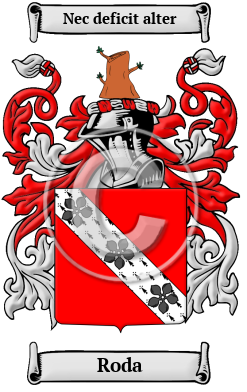
The motto was originally a war cry or slogan. Mottoes first began to be shown with arms in the 14th and 15th centuries, but were not in general use until the 17th century. Thus the oldest coats of arms generally do not include a motto. Mottoes seldom form part of the grant of arms: Under most heraldic authorities, a motto is an optional component of the coat of arms, and can be added to or changed at will; many families have chosen not to display a motto.
Motto: Nec deficit alter
Motto Translation: Another succeeds.
- Lewis, Samuel, A Topographical Dictionary of England. Institute of Historical Research, 1848, Print.
- Hanks, Patricia and Flavia Hodges, A Dictionary of Surnames. Oxford: Oxford University Press, 1988. Print. (ISBN 0-19-211592-8)
- http://www.journaldesfemmes.com/nom-de-famille/nom/
- Filby, P. William, Meyer, Mary K., Passenger and immigration lists index : a guide to published arrival records of about 500,000 passengers who came to the United States and Canada in the seventeenth, eighteenth, and nineteenth centuries. 1982-1985 Cumulated Supplements in Four Volumes Detroit, Mich. : Gale Research Co., 1985, Print (ISBN 0-8103-1795-8)
 |