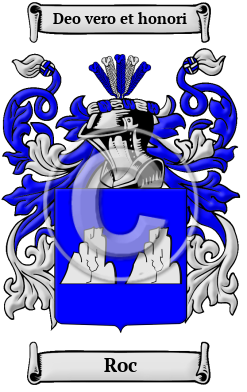
| ![Show Contents]() Roc History, Family Crest & Coats of Arms Roc History, Family Crest & Coats of Arms
- Origins Available:
France
Etymology of RocWhat does the name Roc mean? Languedoc is the region of ancient France from which the name Roc was derived. It comes from when the family lived in La Rocque, in l'Herault, Languedoc. Early Origins of the Roc familyThe surname Roc was first found in Languedoc where the family has held a family seat since ancient times. Early History of the Roc familyThis web page shows only a small excerpt of our Roc research. Another 460 words (33 lines of text) covering the years 1090, 1112, 1132, 1280, 1303, 1372, 1500, 1541, 1550, 1581, 1582, 1620, 1704, 1709, 1746, 1760 and 1762 are included under the topic Early Roc History in all our PDF Extended History products and printed products wherever possible. Roc Spelling VariationsMost surnames have experienced slight spelling changes. A son may not chose to spell his name the same way that his father did. Many were errors, many deliberate. During the early development of the French language, a person usually gave his version, phonetically, to a scribe, a priest, or a recorder. Prefixes or suffixes varied. They were optional as they passed through the centuries, or were adopted by different branches to signify either a political or religious adherence. Hence, there a many spelling variations of the name Roc, including La Roque, Roque, De Roque, du Roque, Rocque, La Rocque, du Rocque, Larocque, Laroc, Roquebrune and many more. Early Notables of the Roc family- John Rocque (1704-1762), originally Jean, a French-born British surveyor and cartographer, best known for his detailed map of London published in 1746...
| Roc migration to New Zealand | + |
Emigration to New Zealand followed in the footsteps of the European explorers, such as Captain Cook (1769-70): first came sealers, whalers, missionaries, and traders. By 1838, the British New Zealand Company had begun buying land from the Maori tribes, and selling it to settlers, and, after the Treaty of Waitangi in 1840, many British families set out on the arduous six month journey from Britain to Aotearoa to start a new life. Early immigrants include: Roc Settlers in New Zealand in the 19th Century- Mr. Edward Roc, (b. 1820), aged 55, British settler travelling from London aboard the ship "Margaret Galbraith" arriving in Port Chalmers, Dunedin, Otago, South Island, New Zealand on 9th January 1875 1
- Mrs. Ann Roc, (b. 1825), aged 50, British settler travelling from London aboard the ship "Margaret Galbraith" arriving in Port Chalmers, Dunedin, Otago, South Island, New Zealand on 9th January 1875 1
- Mr. William Roc, (b. 1860), aged 15, British settler travelling from London aboard the ship "Margaret Galbraith" arriving in Port Chalmers, Dunedin, Otago, South Island, New Zealand on 9th January 1875 1
- Miss Emily Roc, (b. 1864), aged 11, British settler travelling from London aboard the ship "Margaret Galbraith" arriving in Port Chalmers, Dunedin, Otago, South Island, New Zealand on 9th January 1875 1
| Contemporary Notables of the name Roc (post 1700) | + |
- Agustí Roc Amador (b. 1971), Spanish ski mountaineer and long-distance runner
The motto was originally a war cry or slogan. Mottoes first began to be shown with arms in the 14th and 15th centuries, but were not in general use until the 17th century. Thus the oldest coats of arms generally do not include a motto. Mottoes seldom form part of the grant of arms: Under most heraldic authorities, a motto is an optional component of the coat of arms, and can be added to or changed at will; many families have chosen not to display a motto.
Motto: Deo vero et honori
Motto Translation: God and the honor
- New Zealand Yesteryears Passenger Lists 1800 to 1900 (Retrieved 17th October 2018). Retrieved from http://www.yesteryears.co.nz/shipping/passlist.html
 |