| ![Show Contents]() Roban History, Family Crest & Coats of Arms Roban History, Family Crest & Coats of Arms
- Origins Available:
Scotland
Etymology of RobanWhat does the name Roban mean? In ancient Scotland, Roban was a Strathclyde-Briton name for someone who lived in Peeblesshire. The Roban surname was also a patronymic name created from the personal name Robin, a pet form of Robert. 1 "That Robin was early considered a diminutive of Robert is shown by an entry in 1483 where the same individual is referred to as Robyne of Hall and Robert of Hall." 2 Early Origins of the Roban familyThe surname Roban was first found in Peeblesshire (Gaelic: Siorrachd nam Pùballan), former county in South-central Scotland, in the present day Scottish Borders Council Area, where they held a family seat from early times and their first records appeared on the early census rolls taken by the early Kings of Scotland to determine the rate of taxation of their subjects. Early History of the Roban familyThis web page shows only a small excerpt of our Roban research. Another 55 words (4 lines of text) are included under the topic Early Roban History in all our PDF Extended History products and printed products wherever possible. Roban Spelling VariationsPrior to the first dictionaries, scribes spelled words according to sound. This, and the fact that Scottish names were repeatedly translated from Gaelic to English and back, contributed to the enormous number of spelling variations in Scottish names. Roban has been spelled Robbins, Robbyns, Robens, Robins, Robin and others. Early Notables of the Roban familyMore information is included under the topic Early Roban Notables in all our PDF Extended History products and printed products wherever possible. Migration of the Roban familyIn such difficult times, the difficulties of raising the money to cross the Atlantic to North America did not seem so large compared to the problems of keeping a family together in Scotland. It was a journey well worth the cost, since it was rewarded with land and freedom the Scots could not find at home. The American War of Independence solidified that freedom, and many of those settlers went on to play important parts in the forging of a great nation. Among them: Edward, Alice, Dorothy, Henry, John, Judith, Joseph, Rachel, Rebecca, Robert, Sam, Thomas Robins all arrived in Virginia between 1635 and 1660; Samuel Robbins settled in New England in 1635.
The motto was originally a war cry or slogan. Mottoes first began to be shown with arms in the 14th and 15th centuries, but were not in general use until the 17th century. Thus the oldest coats of arms generally do not include a motto. Mottoes seldom form part of the grant of arms: Under most heraldic authorities, a motto is an optional component of the coat of arms, and can be added to or changed at will; many families have chosen not to display a motto.
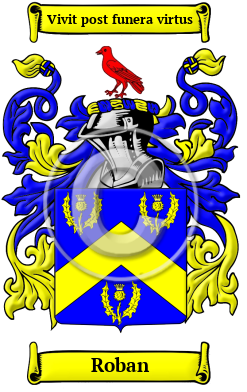
Motto: Vivit post funera virtus
Motto Translation: Virtue lives after death
- Lower, Mark Anthony, Patronymica Britannica, A Dictionary of Family Names of the United Kingdom. London: John Russel Smith, 1860. Print.
- Black, George F., The Surnames of Scotland Their Origin, Meaning and History. New York: New York Public Library, 1946. Print. (ISBN 0-87104-172-3)
 |