| ![Show Contents]() Reyas History, Family Crest & Coats of Arms Reyas History, Family Crest & Coats of Arms
Etymology of ReyasWhat does the name Reyas mean? A Strathclyde-Briton family from the Scottish/English Borderlands was the first to use the surname Reyas. It is a name for a person known as a timid or shy person. Further research revealed that the name is derived from the Old English word ray, that referred to a roe or female deer. 1 Early Origins of the Reyas familyThe surname Reyas was first found in Cumberland at Gill, in the parish of Bromfield which belonged to the family from the time of William the Lion, king of Scotland (died 1214.) "Tradition says, that the original Ray was a faithful adherent of the Scottish monarch, by whom he was greatly esteemed, for his extraordinary swiftness of foot in pursuing the deer and who gave him the estate. The tenure was by a pepper-com rent, with the stipulation, that the name of William should be perpetuated in the family. This was strictly observed from generation to generation, until the latter half of the last [of the 18th] century, when the Mr. William Reay in possession gave to the ' hope of the house ' the name of John. " 1 Thomas filius Ray witnessed confirmation by Alexander, son of Walter, of his father's gift to the church of Paisley in 1239. 2 While there is no doubt of the family's origin in the north of England, the Hundredorum Rolls of 1273 list Reginald le Raye, in Oxfordshire; Nicholas le Ray in Suffolk; and Richard le Ray in Cambridgeshire. 3 Early History of the Reyas familyThis web page shows only a small excerpt of our Reyas research. Another 245 words (18 lines of text) covering the years 1350, 1376, 1465, 1487, 1530, 1558, 1612, 1627, 1670, 1671, 1705, 1748 and 1890 are included under the topic Early Reyas History in all our PDF Extended History products and printed products wherever possible. Reyas Spelling VariationsBefore the printing press standardized spelling in the last few hundred years, no general rules existed in the English language. Spelling variations in Scottish names from the Middle Ages are common even within a single document. Reyas has been spelled Rae, Rea, Ree, Ray and others. Early Notables of the Reyas familyWilliam Rae (d. 1376) a 14th century Bishop of Glasgow.
Centuries later, John Ray (1627-1705) was an English naturalist, who was one of the early botanical and zoological systematists, eponym of the fish named ray.
James Rae (1671-1748), was a Scottish mechanic and historian, son of a clockmaker, born at Dumfries. He constructed for the Duke of QueensBerry at Drumlanrig...
Another 58 words (4 lines of text) are included under the topic Early Reyas Notables in all our PDF Extended History products and printed products wherever possible. Migration of the Reyas family to IrelandSome of the Reyas family moved to Ireland, but this topic is not covered in this excerpt.
Another 70 words (5 lines of text) about their life in Ireland is included in all our PDF Extended History products and printed products wherever possible. Migration of the Reyas familyFor Scottish immigrants, the great expense of travel to North America did not seem such a problem in those unstable times. Acres of land awaited them and many got the chance to fight for their freedom in the American War of Independence. These Scots and their ancestors went on to play important roles in the forging of the great nations of the United States and Canada. Among them: John Rae who settled in Nevis in 1663; William Rae settled in Philadelphia in 1880; Andrew Rea settled in Charles Town [Charleston], South Carolina in 1767.
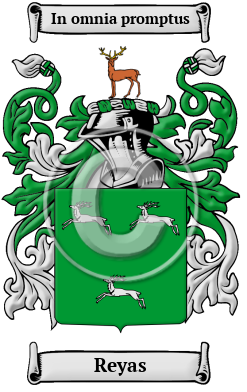
The motto was originally a war cry or slogan. Mottoes first began to be shown with arms in the 14th and 15th centuries, but were not in general use until the 17th century. Thus the oldest coats of arms generally do not include a motto. Mottoes seldom form part of the grant of arms: Under most heraldic authorities, a motto is an optional component of the coat of arms, and can be added to or changed at will; many families have chosen not to display a motto.
Motto: In omnia promptus
Motto Translation: Ready for everything.
- Lower, Mark Anthony, Patronymica Britannica, A Dictionary of Family Names of the United Kingdom. London: John Russel Smith, 1860. Print.
- Black, George F., The Surnames of Scotland Their Origin, Meaning and History. New York: New York Public Library, 1946. Print. (ISBN 0-87104-172-3)
- Bardsley, C.W, A Dictionary of English and Welsh Surnames: With Special American Instances. Wiltshire: Heraldry Today, 1901. Print. (ISBN 0-900455-44-6)
 |