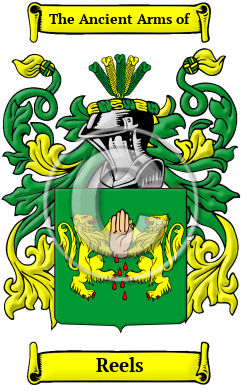
| ![Show Contents]() Reels History, Family Crest & Coats of Arms Reels History, Family Crest & Coats of Arms
- Origins Available:
Ireland
Etymology of ReelsWhat does the name Reels mean? The Reels surname originally appeared in Gaelic as Ó Raghailligh, which means descendant of Raghallach. Early Origins of the Reels familyThe surname Reels was first found in County Cavan. They were known as the Princes of East Breffny, descended from Raghallaigh, Prince of Breffny in 981. They maintained their territory during the Anglo/Norman invasion of Strongbow, Earl of Pembroke, in 1172, but Sir John O'Reilly, Prince of Breffny surrendered the principality to Queen Elizabeth I thereby ensuring that his territories remained intact. Early History of the Reels familyThis web page shows only a small excerpt of our Reels research. Another 95 words (7 lines of text) covering the years 1598, 1630, 1640, 1646, 1667, 1669, 1689, 1691, 1695 and 1703 are included under the topic Early Reels History in all our PDF Extended History products and printed products wherever possible. Reels Spelling VariationsIrish names were rarely spelled consistently in the Middle Ages. Spelling variations of the name Reels dating from that time include O'Reilly, O'Reilley, O'Reily, O'Rielly, O'Riely, O'Riley, O'Rilley, Reel and many more. Early Notables of the Reels familyCount John O'Reilly; Edmund O'Reilly (1598-1669), Roman Catholic Archbishop of Armagh; Hugh Reily (Reilly or O’Reilly) (c.1630-1695) Irish Member of Parliament for Cavan Borough in the Patriot Parliament of 1689; Philip Og O’Reilly (Gaelic was Phillip Óg O’Raghallaigh)(c.1640-1703), Irish politician, Member of Parliament for Cavan Borough in the...
Another 48 words (3 lines of text) are included under the topic Early Reels Notables in all our PDF Extended History products and printed products wherever possible. Migration of the Reels familyTo escape the religious and political discrimination they experienced primarily at the hands of the English, thousands of Irish left their homeland in the 19th century. These migrants typically settled in communities throughout the East Coast of North America, but also joined the wagon trains moving out to the Midwest. Ironically, when the American War of Independence began, many Irish settlers took the side of England, and at the war's conclusion moved north to Canada. These United Empire Loyalists, were granted land along the St. Lawrence River and the Niagara Peninsula. Other Irish immigrants settled in Newfoundland, the Ottawa Valley, New Brunswick and Nova Scotia. The greatest influx of Irish immigrants, however, came to North America during the Great Potato Famine of the late 1840s. Thousands left Ireland at this time for North America and Australia. Many of those numbers, however, did not live through the long sea passage. These Irish settlers to North America were immediately put to work building railroads, coal mines, bridges, and canals. Irish settlers made an inestimable contribution to the building of the New World. Early North American immigration records have revealed a number of people bearing the Irish name Reels or a variant listed above, including: the families who settled in Newfoundland - in St. John's, Tilton Harbour, Placientia, Tickle Bay, Tilt Cove, and many more, between 1805 and 1871; James O'.
 |