| ![Show Contents]() Reddings History, Family Crest & Coats of Arms Reddings History, Family Crest & Coats of Arms
- Origins Available:
England
Etymology of ReddingsWhat does the name Reddings mean? Reddings is a name of ancient Anglo-Saxon origin and comes from the family once having lived in the village of Reading found in the county of Berkshire. 1 2 3 The surname Reddings is a topographic surname, which was given to a person who resided near a physical feature such as a hill, stream, church, or type of tree. In this case the surname was originally derived from the Old English word rydding which simply refers to an area that has been cleared. 4 "This place is unquestionably of great antiquity, but whether it owes its foundation to the Romans or to the Saxons is a matter involved in great doubt. Its name rather tends to strengthen the supposition that its origin is to be attributed to the latter people, the term Reading being most probably derived from the Saxon words Rhea, 'a river' or 'an overflowing,' and Ing, 'a meadow.' "5 Early Origins of the Reddings familyThe surname Reddings was first found in Sussex. Some of the earliest records of the surname were: Robert de Reading (died 1325), English historian and a monk of Westminster; and John of Reading (Latin: Johannes de Reading, Johannes Radingia) who died 1346. He was an English Franciscan theologian and scholastic philosopher and follower of Duns Scotus. He wrote a commentary on the Four Books of Sentences written by Peter Lombard around 1320, at the University of Oxford. In 1322, he accepted a teaching position at Avignon and it was there that he died. Early rolls proved the widespread use of the the name with various spellings: Grifin del Ruding in the Assize Rolls for Lancashire in 1246; Richard del Ryding at Wakefield, Yorkshire in 1227 and Sara de Redyngg in Colchester, Essex in 1311. 4 Early Norfolk records show Henry de Reding was Rector of Matlask, Norfolk in 1305; and John de Reding was Rector of Aldeburgh, Norfolk in 1328. 6 "The Readings, who have their principal home in this county, being also now found in Bucks and Oxfordshire, are probably the modern representatives of the Rædings, a Saxon Clan, that gave their name to their settlements in Derbyshire and in the eastern counties." 7 Early History of the Reddings familyThis web page shows only a small excerpt of our Reddings research. Another 112 words (8 lines of text) covering the years 1588, 1621, 1645, 1667, 1674, 1677, 1686, 1692, 1714, 1744, 1747, 1748, 1757, 1758 and 1767 are included under the topic Early Reddings History in all our PDF Extended History products and printed products wherever possible. Reddings Spelling VariationsSound was what guided spelling in the essentially pre-literate Middle Ages, so one person's name was often recorded under several variations during a single lifetime. Also, before the advent of the printing press and the first dictionaries, the English language was not standardized. Therefore, spelling variations were common, even among the names of the most literate people. Known variations of the Reddings family name include Reading, Reding, Redding, Reddin and others. Early Notables of the Reddings familyJohn Reading (1588-1667), English Calvinist and Biblical commentator; Sir James Reading; John Reading (c.1645-1692), English composer and organist, Choir master of Chichester Cathedral (1674-1677); and John Reading (1686-1767), Acting Colonial Governor...
Another 31 words (2 lines of text) are included under the topic Early Reddings Notables in all our PDF Extended History products and printed products wherever possible. Migration of the Reddings familyFor political, religious, and economic reasons, thousands of English families boarded ships for Ireland, Canada, the America colonies, and many of smaller tropical colonies in the hope of finding better lives abroad. Although the passage on the cramped, dank ships caused many to arrive in the New World diseased and starving, those families that survived the trip often went on to make valuable contributions to those new societies to which they arrived. Early immigrants bearing the Reddings surname or a spelling variation of the name include: Henry Readding, James Readding, Jeremy Readding and Richard Readding, who all arrived in Virginia in 1634; Miles and Joseph Reading, who came to Salem in 1630.
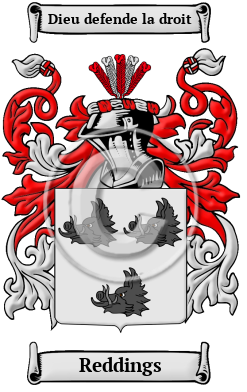
The motto was originally a war cry or slogan. Mottoes first began to be shown with arms in the 14th and 15th centuries, but were not in general use until the 17th century. Thus the oldest coats of arms generally do not include a motto. Mottoes seldom form part of the grant of arms: Under most heraldic authorities, a motto is an optional component of the coat of arms, and can be added to or changed at will; many families have chosen not to display a motto.
Motto: Dieu defende la droit
Motto Translation: God defends the right.
- Bardsley, C.W, A Dictionary of English and Welsh Surnames: With Special American Instances. Wiltshire: Heraldry Today, 1901. Print. (ISBN 0-900455-44-6)
- Smith, Eldson Coles, New Dictionary of American Family Names New York: Harper & Row, 1956. Print
- Lower, Mark Anthony, Patronymica Britannica, A Dictionary of Family Names of the United Kingdom. London: John Russel Smith, 1860. Print.
- Reaney, P.H and R.M. Wilson, A Dictionary of English Surnames. London: Routledge, 1991. Print. (ISBN 0-415-05737-X)
- Lewis, Samuel, A Topographical Dictionary of England. Institute of Historical Research, 1848, Print.
- Rye, Walter, A History of Norfolk. London: Elliot Stock, 62, Paternoster Row, 1885. Print
- Guppy, Henry Brougham, Homes of Family Names in Great Britain. 1890. Print.
 |