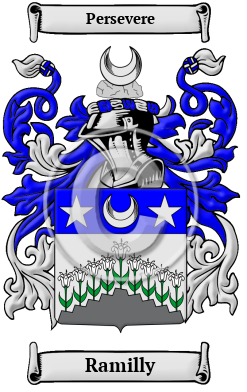
| ![Show Contents]() Ramilly History, Family Crest & Coats of Arms Ramilly History, Family Crest & Coats of Arms
- Origins Available:
England
Etymology of RamillyWhat does the name Ramilly mean? The name Ramilly was brought to England in the wave of migration that followed the Norman Conquest of 1066. The Ramilly family lived in Cambridgeshire. Their name, however, is a reference to Romily, near Eure, Normandy, the family's place of residence prior to the Norman Conquest of England in 1066. 1 Early Origins of the Ramilly familyThe surname Ramilly was first found in Cambridgeshire, England where they were anciently Lords of the Manor. The family emerged from Normandy where they held a knights fee at Eure, in the arrondisement of Les Andelys, in the canton of Fleury-sur-Andelle. As to what time Richard de Romilly arrived and gained an interest in the villages of Girton and Barton in the county of Cambridge is unknown. There was conflict between two Norman nobles, Roger de Tosny and Richard de Romilly between 1190 and 1200. Overriding this dispute was another Norman Lord, Gilbert de Miners, who eventually lost these lands, and other unnamed lands in Buckinghamshire. The Pipe Rolls for Oxfordshire show entries for Alexander de Romeilli in 1190 and Alexander Rumeilli in 1193 (these may be the same person). Early Cumberland records list Alice de Romeilli in 1197 and Alice de Rumelly in Yorkshire in 1230. Alan de Romely who is listed in the Assize Rolls for Staffordshire "may have come from Romiley, Cheshire." 2 The Hundredorum Rolls of 1237 included entries for Robert de Romeley, Cambridgeshire; Baldwin de Romeli, Cambridgeshire; and Lucia de Romely, Cambridgeshire. 3 "William de Romillé was the first Baron of Skipton, Yorkshire." 4 "The great grandfather of the late Sir Samuel Romilly 'had a pretty good landed estate at Montpellier in the south of France.' His son, in the year 1701, being a Protestant, visited Geneva, for the sole purpose of receiving the sacrament, and, by the advice of the celebrated theologian, Saurin, instead of returning to Montpellier, set out for London, and thus at length established the family in England. Memoirs of Sir S. Romilly, vol. i., p. 2. The name may have been borrowed from the town of Romilly, in Savoy, near Geneva. " 5 Early History of the Ramilly familyThis web page shows only a small excerpt of our Ramilly research. Another 224 words (16 lines of text) covering the years 1086, 1757, 1791, 1802, 1818, 1856, 1864, 1874, 1879, 1891 and 1892 are included under the topic Early Ramilly History in all our PDF Extended History products and printed products wherever possible. Ramilly Spelling VariationsNorman surnames are characterized by a multitude of spelling variations. The frequent changes in surnames are largely due to the fact that the Old and Middle English languages lacked definite spelling rules. The introduction of Norman French to England, as well as the official court languages of Latin and French, also had pronounced influences on the spelling of surnames. Since medieval scribes and church officials recorded names as they sounded, rather than adhering to any specific spelling rules, it was common to find the same individual referred to with different spellings. The name has been spelled Remely, Remelly, Remilly, Remmilly, Remilley, Remiley, Romilly, Rommilly, Romiley and many more. Early Notables of the Ramilly familySir Samuel Romilly (1757-1818), law reformer, youngest son of Peter Romilly, jeweller, of Frith Street, Soho, by Margaret, daughter of Aimé Garnault, was born in Westminster on 1 March 1757. His father was a younger son of Etienne Romilly, a Huguenot of good family and estate, who fled from Montpellier to England on the revocation of the edict of Nantes, by Judith, second daughter of François de Montsallier, merchant, of Shoreditch. 6
Joseph Romilly (1791-1864), Registrary of the University of Cambridge, born in 1791, was son of Thomas Peter Romilly of London, by his cousin Jane Anne, second daughter of Isaac Romilly...
Another 162 words (12 lines of text) are included under the topic Early Ramilly Notables in all our PDF Extended History products and printed products wherever possible. Migration of the Ramilly familyMany English families emigrated to North American colonies in order to escape the political chaos in Britain at this time. Unfortunately, many English families made the trip to the New World under extremely harsh conditions. Overcrowding on the ships caused the majority of the immigrants to arrive diseased, famished, and destitute from the long journey across the stormy Atlantic. Despite these hardships, many of the families prospered and went on to make invaluable contributions to the development of the cultures of the United States and Canada. Early North American immigration records have revealed a number of people bearing the name Ramilly or a variant listed above: Ambrose Remely who settled in Philadelphia, Pennsylvania in 1749.
The motto was originally a war cry or slogan. Mottoes first began to be shown with arms in the 14th and 15th centuries, but were not in general use until the 17th century. Thus the oldest coats of arms generally do not include a motto. Mottoes seldom form part of the grant of arms: Under most heraldic authorities, a motto is an optional component of the coat of arms, and can be added to or changed at will; many families have chosen not to display a motto.
Motto: Persevere
- The Norman People and Their Existing Descendants in the British Dominions and the United States Of America. Baltimore: Genealogical Publishing, 1975. Print. (ISBN 0-8063-0636-X)
- Reaney, P.H and R.M. Wilson, A Dictionary of English Surnames. London: Routledge, 1991. Print. (ISBN 0-415-05737-X)
- Bardsley, C.W, A Dictionary of English and Welsh Surnames: With Special American Instances. Wiltshire: Heraldry Today, 1901. Print. (ISBN 0-900455-44-6)
- Barber, Henry, British Family Names London: Elliot Stock, 62 Paternoster Row, 1894. Print.
- Lower, Mark Anthony, Patronymica Britannica, A Dictionary of Family Names of the United Kingdom. London: John Russel Smith, 1860. Print.
- Smith, George (ed), Dictionary of National Biography. London: Smith, Elder & Co., 1885-1900. Print
 |